

700
14 Electromagnetism II
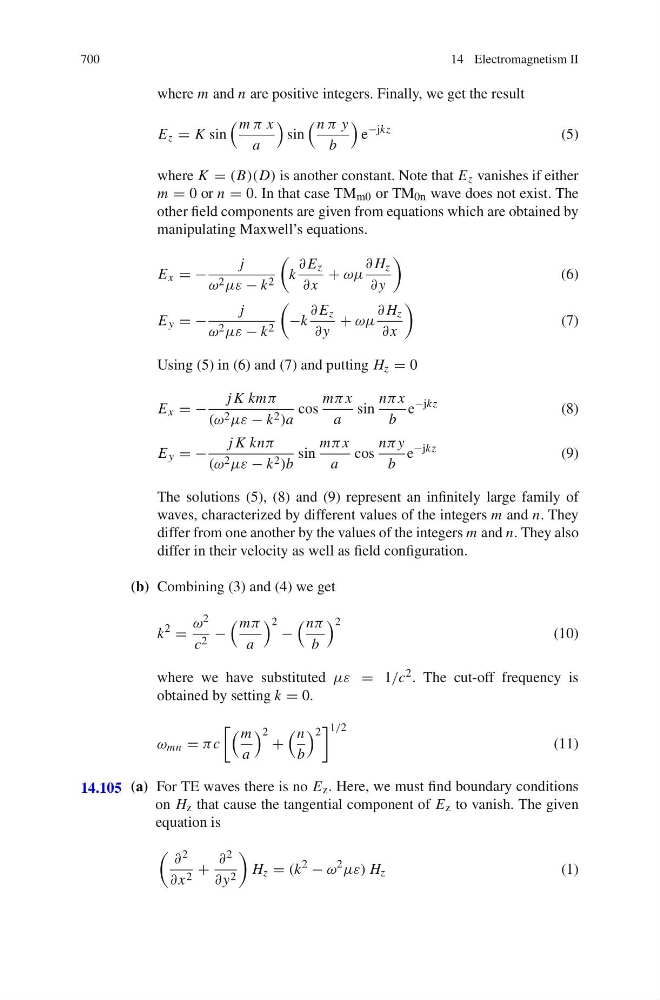
where m and n are positive integers. Finally, we get the result
E z = K sin
m π x
a
sin
n π y
b
e
−jkz
(5)
where K = (B)(D) is another constant. Note that E z vanishes if either
m = 0 or n = 0. In that case TM m0 or TM 0n wave does not exist. The
other field components are given from equations which are obtained by
manipulating Maxwell’s equations.
E x = −
j
ω 2 με − k 2
k
∂ E z
∂ x
+ ωμ
∂ H z
∂ y
(6)
E y = −
j
ω 2 με − k 2
−k
∂ E z
∂ y
+ ωμ
∂ H z
∂ x
(7)
Using (5) in (6) and (7) and putting H z = 0
E x = −
j K kmπ
(ω 2 με − k 2 )a
cos
mπ x
a
sin
nπ x
b
e
−jkz
(8)
E y = −
j K knπ
(ω 2 με − k 2 )b
sin
mπ x
a
cos
nπ y
b
e
−jkz
(9)
The solutions (5), (8) and (9) represent an infinitely large family of
waves, characterized by different values of the integers m and n. They
differ from one another by the values of the integers m and n. They also
differ in their velocity as well as field configuration.
(b) Combining (3) and (4) we get
k
2
=
ω 2
c 2 −
mπ
a
2 −
nπ
b
2
(10)
where we have substituted με = 1/c 2 . The cut-off frequency is
obtained by setting k = 0.
ω mn = π c
m
a
2 +
n
b
2
1/2
(11)
14.105 (a) For TE waves there is no E z . Here, we must find boundary conditions
on H z that cause the tangential component of E z to vanish. The given
equation is
∂ 2
∂ x 2 +
∂ 2
∂ y 2
H z = (k
2
− ω
2
με) H z
(1)