

698
14 Electromagnetism II
14.103 The relation between ω and k in a rectangular waveguide is
k
2
=
ω 2
c 2 −
mπ
a
2 −
nπ
b
2
(1)
For TE 01 waves m = 0, n = 1, a = 1 cm and b = 2 cm. Equation (1) is
then reduced to
k
2
=
ω 2
c 2 −
π
0.02
2
(2)
The phase velocity is given by
v p =
ω
k
(3)
The group velocity ν g is given by
v g =
dω
dk
(4)
v g =
dω
dk
=
kc 2
ω
=
c 2
v p
or v p v g = c
2
(5)
The cut-off frequency is given by
ω 01 =
π c
b
(6)
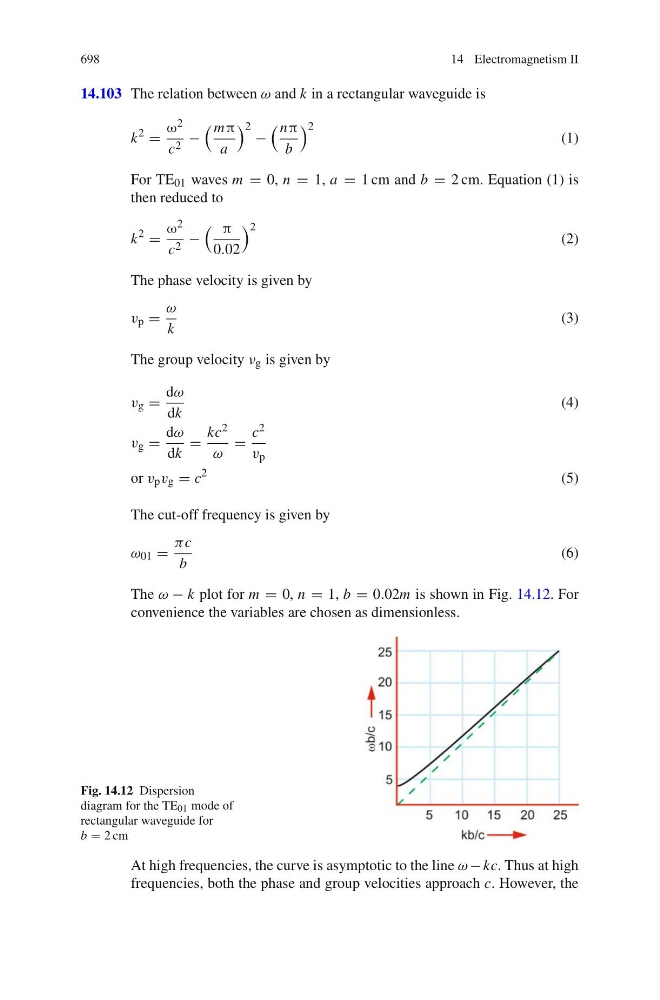
The ω − k plot for m = 0, n = 1, b = 0.02m is shown in Fig. 14.12. For
convenience the variables are chosen as dimensionless.
Fig. 14.12 Dispersion
diagram for the TE 01 mode of
rectangular waveguide for
b = 2 cm
At high frequencies, the curve is asymptotic to the line ω − kc. Thus at high
frequencies, both the phase and group velocities approach c. However, the