

690
14 Electromagnetism II
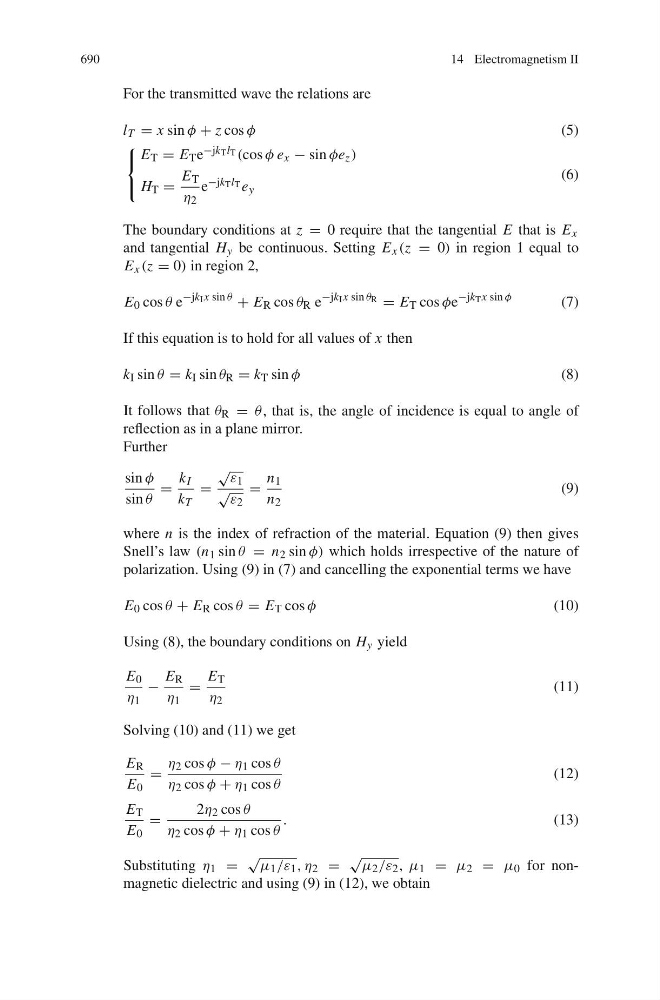
For the transmitted wave the relations are
l T = x sin φ + z cos φ
(5)
⎧
⎨
⎩
E T = E T e −jk T l T (cos φ e x − sin φe z )
H T =
E T
η 2
e −jk T l T e y
(6)
The boundary conditions at z = 0 require that the tangential E that is E x
and tangential H y be continuous. Setting E x (z = 0) in region 1 equal to
E x (z = 0) in region 2,
E 0 cos θ e
−jk I x sin θ
+ E R cos θ R e
−jk I x sin θ R = E T cos φe
−jk T x sin φ
(7)
If this equation is to hold for all values of x then
k I sin θ = k I sin θ R = k T sin φ
(8)
It follows that θ R = θ , that is, the angle of incidence is equal to angle of
reflection as in a plane mirror.
Further
sin φ
sin θ
=
k I
k T
=
√ ε 1
√ ε 2
=
n 1
n 2
(9)
where n is the index of refraction of the material. Equation (9) then gives
Snell’s law (n 1 sin θ = n 2 sin φ) which holds irrespective of the nature of
polarization. Using (9) in (7) and cancelling the exponential terms we have
E 0 cos θ + E R cos θ = E T cos φ
(10)
Using (8), the boundary conditions on H y yield
E 0
η 1
−
E R
η 1
=
E T
η 2
(11)
Solving (10) and (11) we get
E R
E 0
=
η 2 cos φ − η 1 cos θ
η 2 cos φ + η 1 cos θ
(12)
E T
E 0
=
2η 2 cos θ
η 2 cos φ + η 1 cos θ
.
(13)
Substituting η 1 =
√ μ 1 /ε 1 , η 2 =
√ μ 2 /ε 2 , μ 1 = μ 2 = μ 0 for nonmagnetic dielectric and using (9) in (12), we obtain