

14.3 Solutions
689
R = ρ
2
=
(n 2 − n 1 )
2
(n 2 + n 1 )
2
(7)
T = τ
2 n 1
n 2
=
2n 2
n 2 + n 1
2 n 1
n 2
=
4n 1 n 2
(n 1 + n 2 ) 2
(8)
Adding (7) and (8) it follows that R + T = 1. This is simply the consequence
of conservation of energy.
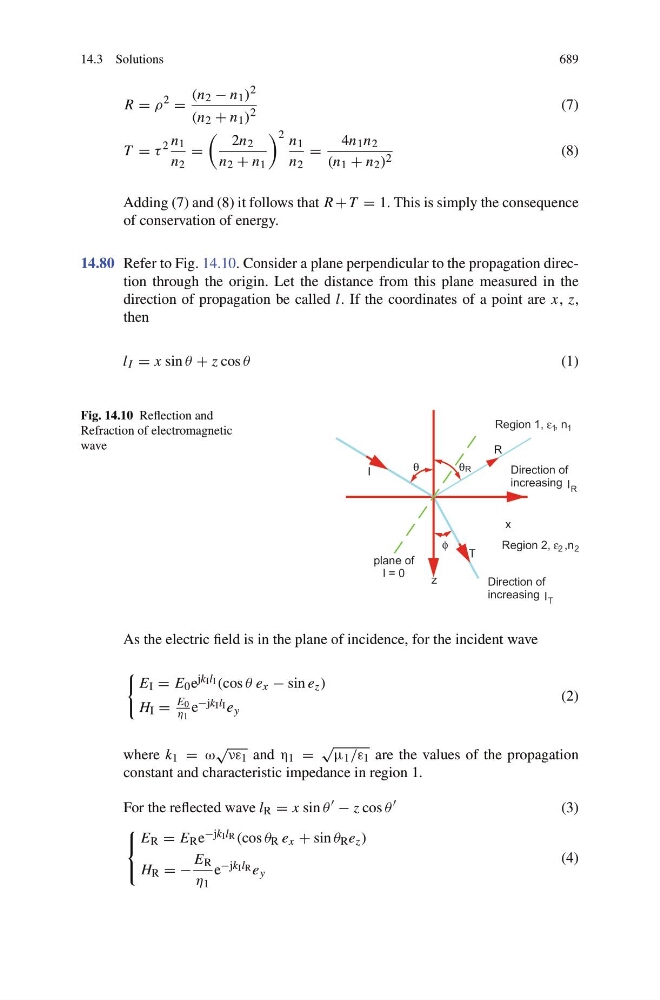
14.80 Refer to Fig. 14.10. Consider a plane perpendicular to the propagation direction through the origin. Let the distance from this plane measured in the
direction of propagation be called l. If the coordinates of a point are x, z,
then
l I = x sin θ + z cos θ
(1)
Fig. 14.10 Reflection and
Refraction of electromagnetic
wave
As the electric field is in the plane of incidence, for the incident wave
E I = E 0 e jk I l I (cos θ e x − sin e z )
H I =
E 0
η 1
e −jk I l I e y
(2)
where k 1 = ω
√ νε 1 and η 1 =
√
μ 1 /ε 1 are the values of the propagation
constant and characteristic impedance in region 1.
For the reflected wave l R = x sin θ
− z cos θ
(3)
⎧
⎨
⎩
E R = E R e −jk I l R (cos θ R e x + sin θ R e z )
H R = −
E R
η 1
e −jk I l R e y
(4)