

688
14 Electromagnetism II
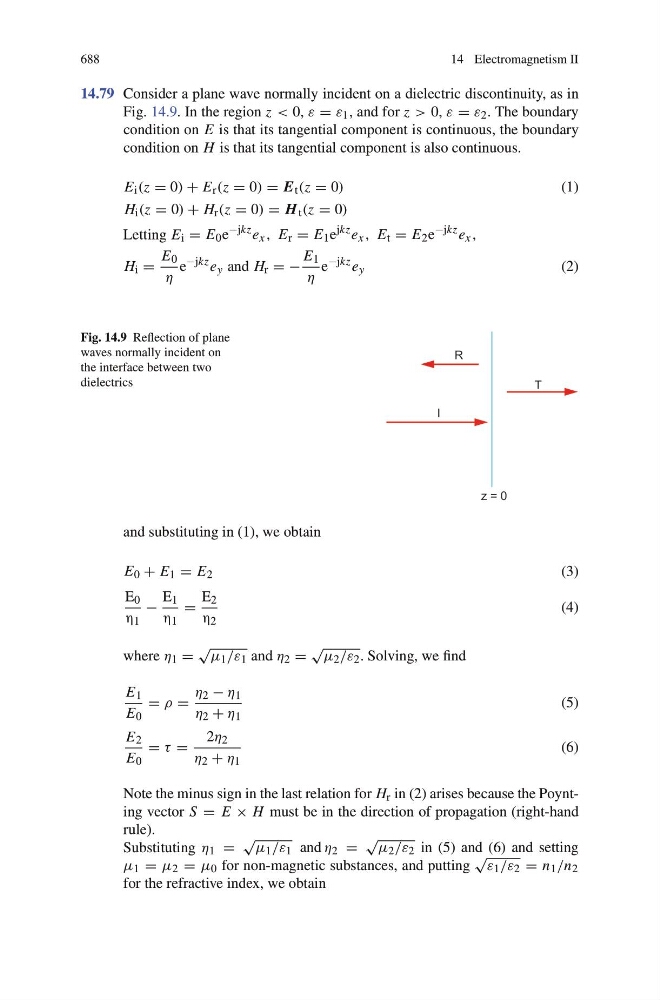
14.79 Consider a plane wave normally incident on a dielectric discontinuity, as in
Fig. 14.9. In the region z < 0, ε = ε 1 , and for z > 0, ε = ε 2 . The boundary
condition on E is that its tangential component is continuous, the boundary
condition on H is that its tangential component is also continuous.
E i (z = 0) + E r (z = 0) = E t (z = 0)
(1)
H i (z = 0) + H r (z = 0) = H t (z = 0)
Letting E i = E 0 e
−jkz e x , E r = E 1 e
jkz e x , E t = E 2 e
−jkz e x ,
H i =
E 0
η
e
−jkz e y and H r = −
E 1
η
e
−jkz e y
(2)
Fig. 14.9 Reflection of plane
waves normally incident on
the interface between two
dielectrics
and substituting in (1), we obtain
E 0 + E 1 = E 2
(3)
E 0
η 1
−
E 1
η 1
=
E 2
η 2
(4)
where η 1 =
√ μ 1 /ε 1 and η 2 =
√ μ 2 /ε 2 . Solving, we find
E 1
E 0
= ρ =
η 2 − η 1
η 2 + η 1
(5)
E 2
E 0
= τ =
2η 2
η 2 + η 1
(6)
Note the minus sign in the last relation for H r in (2) arises because the Poynting vector S = E × H must be in the direction of propagation (right-hand
rule).
Substituting η 1 =
√ μ 1 /ε 1 and η 2 =
√
μ 2 /ε 2 in (5) and (6) and setting
μ 1 = μ 2 = μ 0 for non-magnetic substances, and putting
√
ε 1 /ε 2 = n 1 /n 2
for the refractive index, we obtain