

14.3 Solutions
687
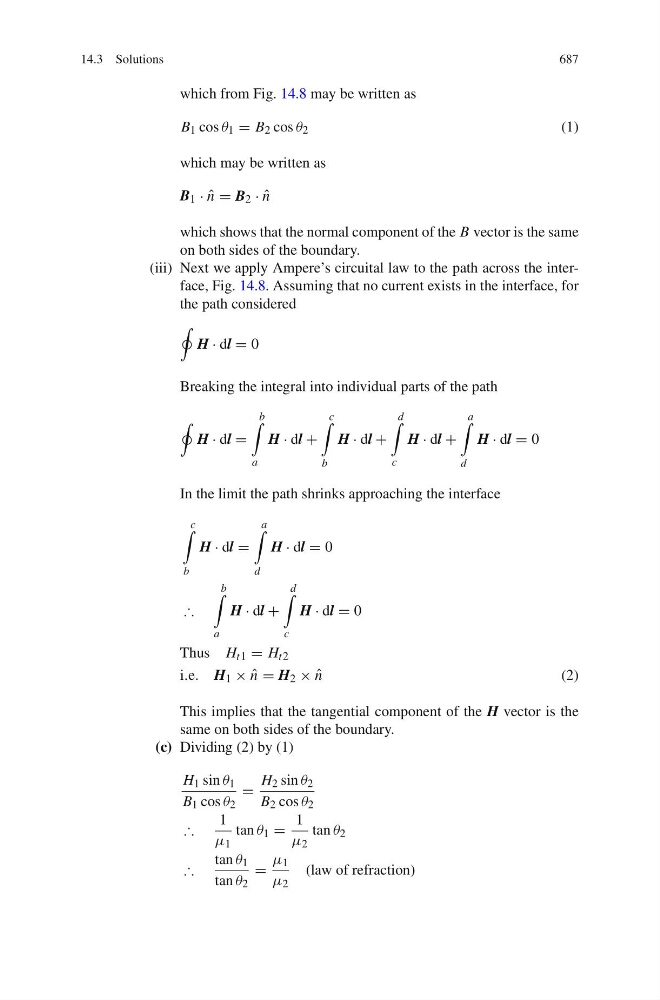
which from Fig. 14.8 may be written as
B 1 cos θ 1 = B 2 cos θ 2
(1)
which may be written as
B 1 · ˆ
n = B 2 · ˆ
n
which shows that the normal component of the B vector is the same
on both sides of the boundary.
(iii) Next we apply Ampere’s circuital law to the path across the interface, Fig. 14.8. Assuming that no current exists in the interface, for
the path considered
H · dl = 0
Breaking the integral into individual parts of the path
H · dl =
b
a
H · dl +
c
b
H · dl +
d
c
H · dl +
a
d
H · dl = 0
In the limit the path shrinks approaching the interface
c
b
H · dl =
a
d
H · dl = 0
∴
b
a
H · dl +
d
c
H · dl = 0
Thus H t1 = H t2
i.e. H 1 × ˆ
n = H 2 × ˆ
n
(2)
This implies that the tangential component of the H vector is the
same on both sides of the boundary.
(c) Dividing (2) by (1)
H 1 sin θ 1
B 1 cos θ 2
=
H 2 sin θ 2
B 2 cos θ 2
∴
1
μ 1
tan θ 1 =
1
μ 2
tan θ 2
∴
tan θ 1
tan θ 2
=
μ 1
μ 2
(law of refraction)