

686
14 Electromagnetism II
Notice that the variation of B is exactly the same as the variation of E, except
that E y and B x are at right angles to each other and perpendicular to the
direction of propagation. From (2) and the relation H x = B x /μ 0 we find
H x =
1
μ 0 v
f (x − vt)
(3)
so that E y = μ 0 v H x
(4)
Using the relation v =
√
1/μ 0 ε 0 , we can write (4) in the form
E y = Z 0 H x
with Z 0 =
μ 0
ε 0
= 376.6 .
14.78 (a) E(z, t) = E 0 [ ˆ
x sin(kz − ωt) + ˆ
y cos(kz − ωt)]. This is a plane polarized wave polarized in the xy-plane and propagating in the positive
z-direction.
(b) The magnetic lines will suffer refraction in passing from one magnetic
medium to another.
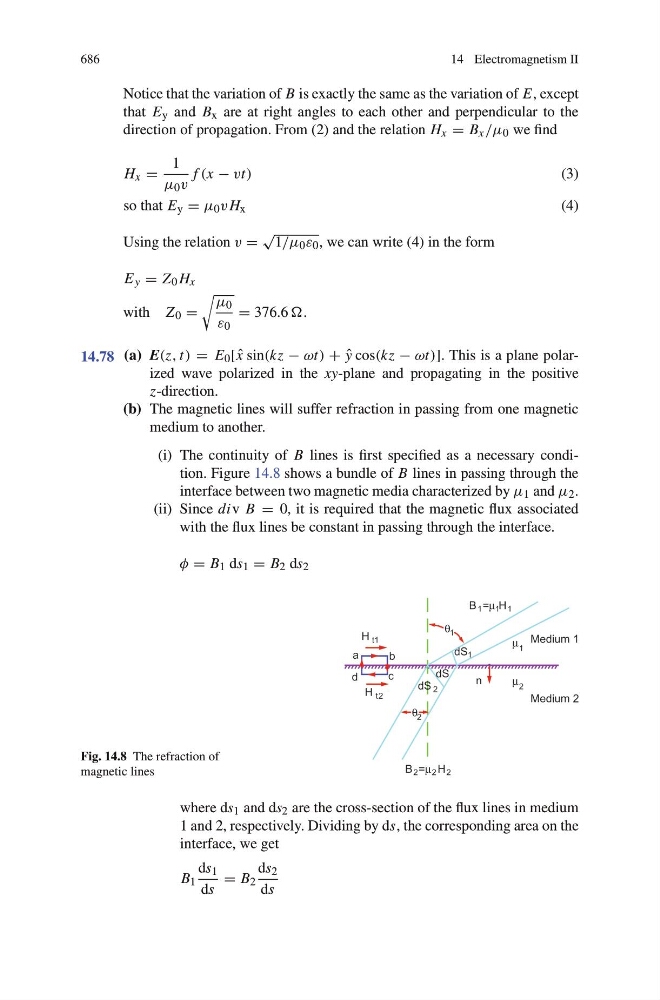
(i) The continuity of B lines is first specified as a necessary condition. Figure 14.8 shows a bundle of B lines in passing through the
interface between two magnetic media characterized by μ 1 and μ 2 .
(ii) Since div B = 0, it is required that the magnetic flux associated
with the flux lines be constant in passing through the interface.
φ = B 1 ds 1 = B 2 ds 2
Fig. 14.8 The refraction of
magnetic lines
where ds 1 and ds 2 are the cross-section of the flux lines in medium
1 and 2, respectively. Dividing by ds, the corresponding area on the
interface, we get
B 1
ds 1
ds
= B 2
ds 2
ds