

14.3 Solutions
691
R =
E 1
E 0
2
=
n 2 cos θ − n 1 cos φ
n 2 cos θ + n 1 cos φ
2
14.81 (a) Reflectance R = 0 if n 2 cos θ − n 1 cos φ = 0
( 1 )
Given tan θ =
n 2
n 1
(Brewster’s law of polarization)
(2)
sin θ
sin φ
=
n 2
n 1
(Snell’s law of refraction)
(3)
Combining (2) and (3), we have (Fig. 14.11)
sin φ = cos θ
(4)
or φ = 90
◦
− θ
(5)
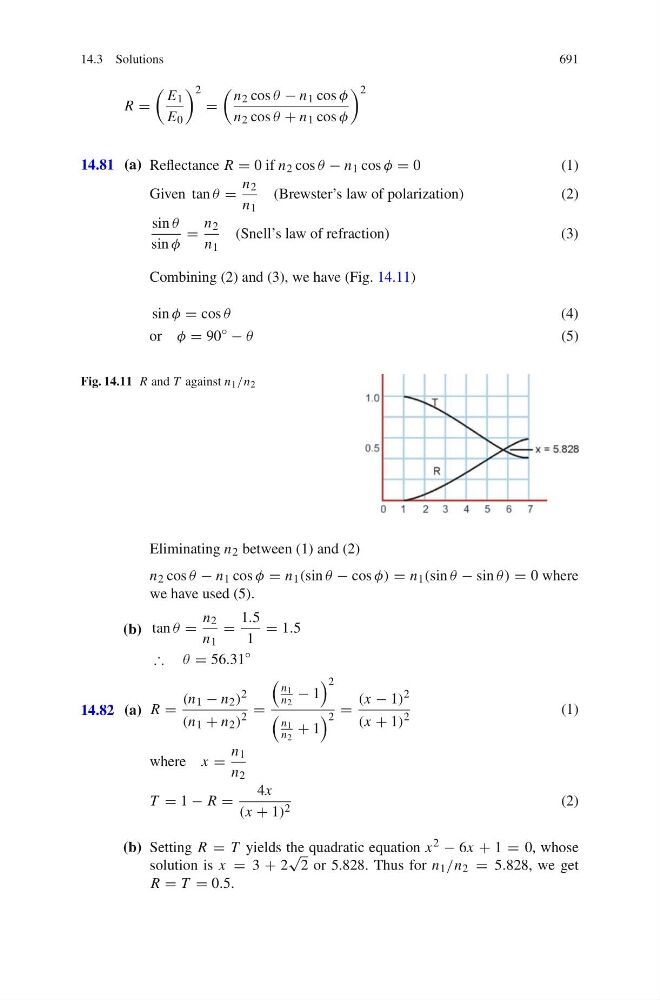
Fig. 14.11 R and T against n 1 /n 2
Eliminating n 2 between (1) and (2)
n 2 cos θ − n 1 cos φ = n 1 (sin θ − cos φ) = n 1 (sin θ − sin θ) = 0 where
we have used (5).
(b) tan θ =
n 2
n 1
=
1.5
1
= 1.5
∴ θ = 56.31
◦
14.82 (a) R =
(n 1 − n 2 )
2
(n 1 + n 2 )
2
=
n 1
n 2
− 1
2
n 1
n 2
+ 1
2 =
(x − 1)
2
(x + 1)
2
(1)
where x =
n 1
n 2
T = 1 − R =
4x
(x + 1) 2
(2)
(b) Setting R = T yields the quadratic equation x 2 − 6x + 1 = 0, whose
solution is x = 3 + 2
√
2 or 5.828. Thus for n 1 /n 2 = 5.828, we get
R = T = 0.5.