

682
14 Electromagnetism II
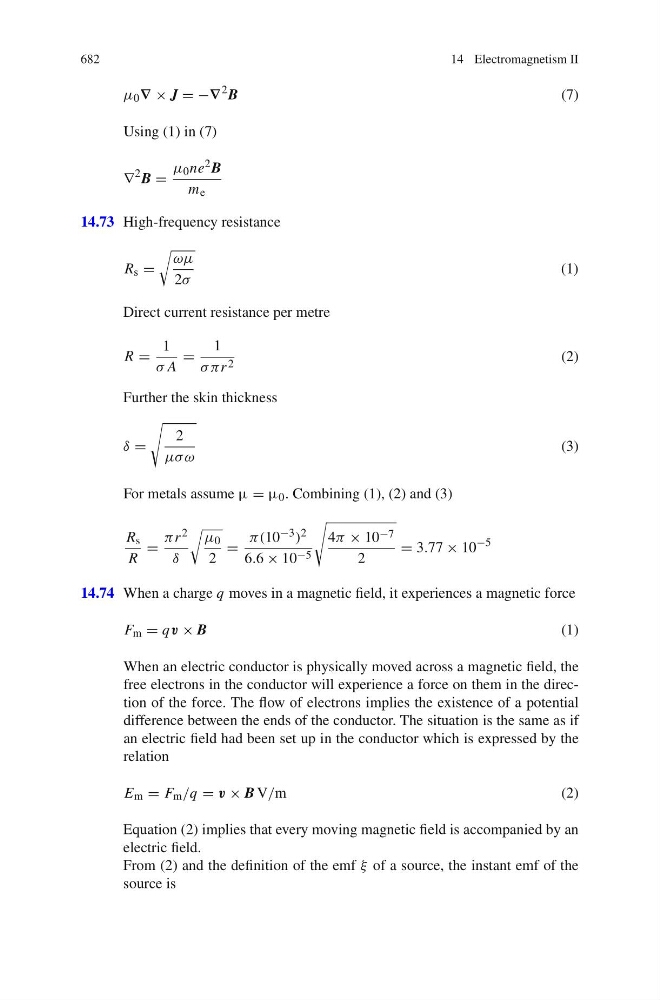
μ 0 ∇ × J = −∇
2 B
(7)
Using (1) in (7)
∇
2 B =
μ 0 ne 2 B
m e
14.73 High-frequency resistance
R s =
ωμ
2σ
(1)
Direct current resistance per metre
R =
1
σ A
=
1
σ πr 2
(2)
Further the skin thickness
δ =
2
μσ ω
(3)
For metals assume μ = μ 0 . Combining (1), (2) and (3)
R s
R
=
πr 2
δ
μ 0
2
=
π(10 −3 ) 2
6.6 × 10 −5
4π × 10 −7
2
= 3.77 × 10
−5
14.74 When a charge q moves in a magnetic field, it experiences a magnetic force
F m = qv × B
(1)
When an electric conductor is physically moved across a magnetic field, the
free electrons in the conductor will experience a force on them in the direction of the force. The flow of electrons implies the existence of a potential
difference between the ends of the conductor. The situation is the same as if
an electric field had been set up in the conductor which is expressed by the
relation
E m = F m /q = v × B V/m
( 2 )
Equation (2) implies that every moving magnetic field is accompanied by an
electric field.
From (2) and the definition of the emf ξ of a source, the instant emf of the
source is