

14.3 Solutions
683
ξ =
E m · dl =
v × B · dl V
( 3 )
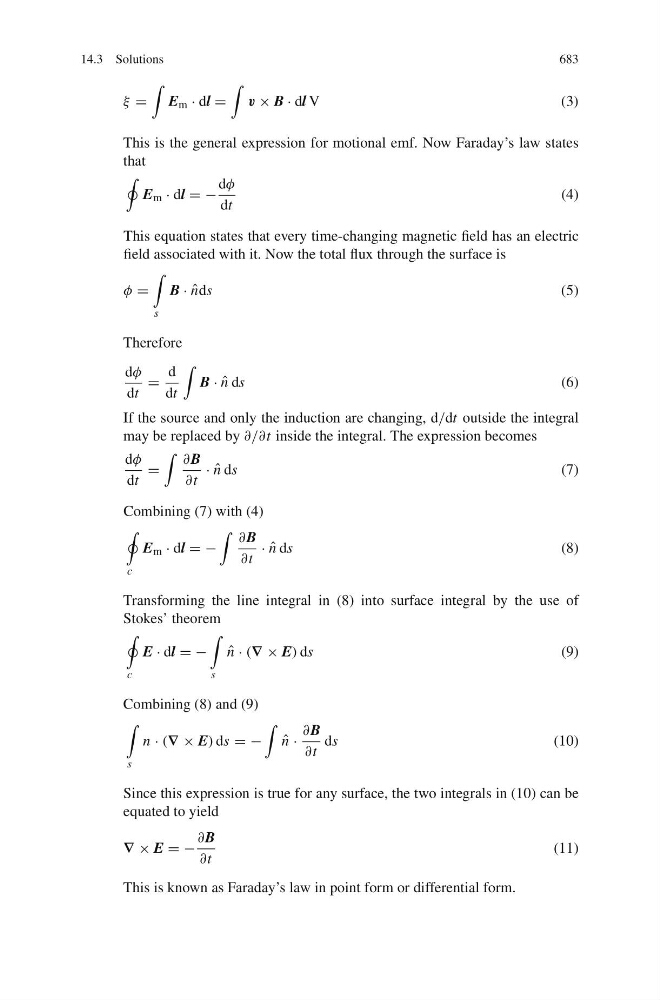
This is the general expression for motional emf. Now Faraday’s law states
that
E m · dl = −
dφ
dt
(4)
This equation states that every time-changing magnetic field has an electric
field associated with it. Now the total flux through the surface is
φ =
s
B · ˆ
nds
(5)
Therefore
dφ
dt
=
d
dt
B · ˆ
n ds
(6)
If the source and only the induction are changing, d/dt outside the integral
may be replaced by ∂/∂t inside the integral. The expression becomes
dφ
dt
=
∂B
∂t
· ˆ
n ds
(7)
Combining (7) with (4)
c
E m · dl = −
∂B
∂t
· ˆ
n ds
(8)
Transforming the line integral in (8) into surface integral by the use of
Stokes’ theorem
c
E · dl = −
s
ˆ
n · (∇ × E) ds
(9)
Combining (8) and (9)
s
n · (∇ × E) ds = −
ˆ
n ·
∂B
∂t
ds
(10)
Since this expression is true for any surface, the two integrals in (10) can be
equated to yield
∇ × E = −
∂B
∂t
(11)
This is known as Faraday’s law in point form or differential form.