

14.3 Solutions
681
If the resistance of the cable cannot be neglected then V is no longer constant.
An axial component of E is necessary to maintain the flow of current to
compensate for the Ohmic energy loss.
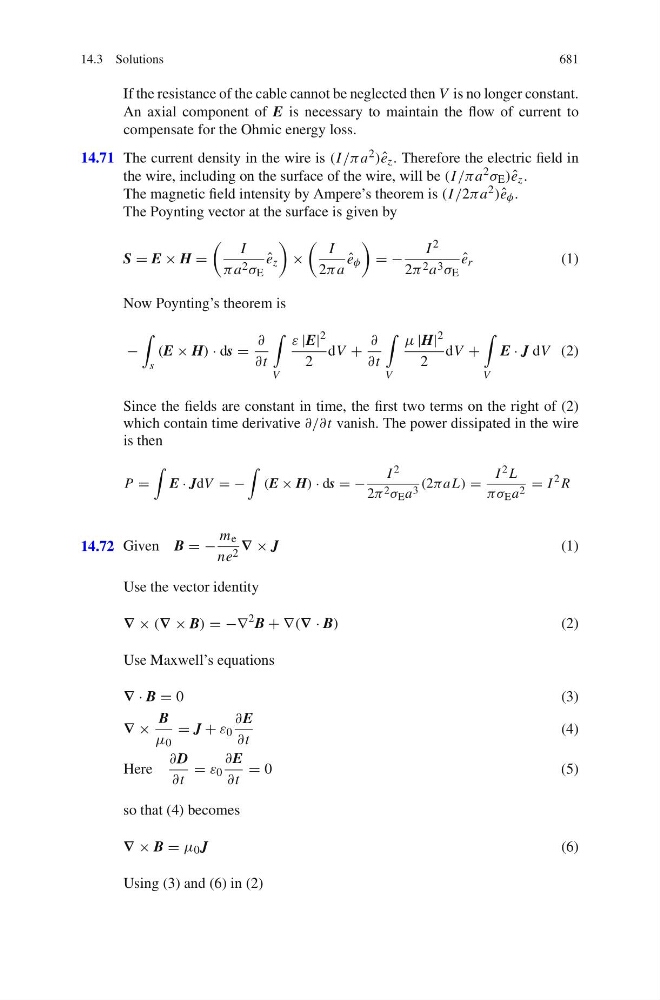
14.71 The current density in the wire is (I /πa 2 ) ˆ
e z . Therefore the electric field in
the wire, including on the surface of the wire, will be (I /πa 2 σ E ) ˆ
e z .
The magnetic field intensity by Ampere’s theorem is (I /2πa 2 ) ˆ
e φ .
The Poynting vector at the surface is given by
S = E × H =
I
πa 2 σ E
ˆ
e z
×
I
2πa
ˆ
e φ
= −
I 2
2π 2 a 3 σ E
ˆ
e r
(1)
Now Poynting’s theorem is
−
s
(E × H) · ds =
∂
∂t
V
ε |E|
2
2
dV +
∂
∂t
V
μ |H|
2
2
dV +
V
E · J dV (2)
Since the fields are constant in time, the first two terms on the right of (2)
which contain time derivative ∂/∂t vanish. The power dissipated in the wire
is then
P =
E · JdV = −
(E × H) · ds = −
I 2
2π 2 σ E a 3 (2πaL) =
I 2 L
πσ E a 2 = I
2 R
14.72 Given B = −
m e
ne 2 ∇ × J
(1)
Use the vector identity
∇ × (∇ × B) = −∇
2 B + ∇(∇ · B)
(2)
Use Maxwell’s equations
∇ · B = 0
( 3 )
∇ ×
B
μ 0
= J + ε 0
∂E
∂t
(4)
Here
∂D
∂t
= ε 0
∂E
∂t
= 0
( 5 )
so that (4) becomes
∇ × B = μ 0 J
(6)
Using (3) and (6) in (2)