

680
14 Electromagnetism II
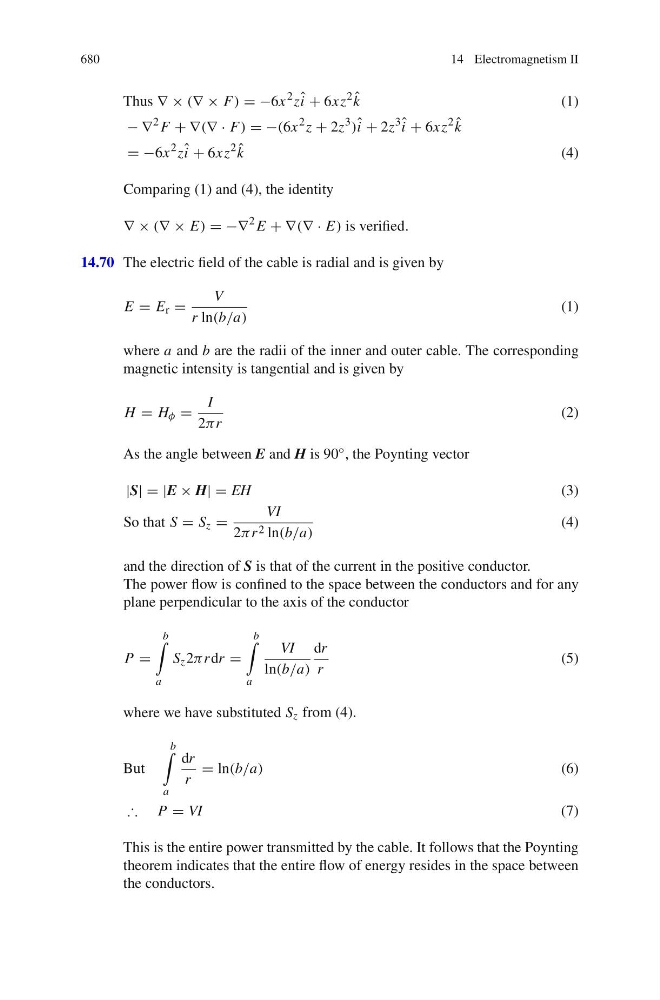
Thus ∇ × (∇ × F) = −6x
2 z ˆ
i + 6xz
2 ˆ
k
(1)
− ∇
2 F + ∇(∇ · F) = −(6x
2 z + 2z
3
) ˆ
i + 2z
3 ˆ
i + 6xz
2 ˆ
k
= −6x
2 z ˆ
i + 6xz
2 ˆ
k
(4)
Comparing (1) and (4), the identity
∇ × (∇ × E) = −∇
2 E + ∇(∇ · E) is verified.
14.70 The electric field of the cable is radial and is given by
E = E r =
V
r ln(b/a)
(1)
where a and b are the radii of the inner and outer cable. The corresponding
magnetic intensity is tangential and is given by
H = H φ =
I
2πr
(2)
As the angle between E and H is 90 ◦ , the Poynting vector
|S| = |E × H| = EH
(3)
So that S = S z =
VI
2πr 2 ln(b/a)
(4)
and the direction of S is that of the current in the positive conductor.
The power flow is confined to the space between the conductors and for any
plane perpendicular to the axis of the conductor
P =
b
a
S z 2πr dr =
b
a
VI
ln(b/a)
dr
r
(5)
where we have substituted S z from (4).
But
b
a
dr
r
= ln(b/a)
(6)
∴ P = VI
(7)
This is the entire power transmitted by the cable. It follows that the Poynting
theorem indicates that the entire flow of energy resides in the space between
the conductors.