

556
12 Electric Circuits
12.8 (i) Let the current in AD, DE and R be i 1 , i 2 and i 3 , respectively:
i 3 = 5 − 2 = 3 A
(by junction theorem)
V AD = V AC + V CD
∴ i 1 × 6 = 5 × 4 + 5 × 2
∴ i 1 = 5 A
∴ i 2 = 2 + 5 = 7 A
V CB = V CD + V DB
3R = 2 × 5 + 7 × 5
∴ R = 15
(ii) V AB = V AC + V CB = 4 × 5 + 15 × 3 = 65 V
(iii) Heat developed per second = power =
i 2
n R n
= 5
2
× 4 + 2
2
× 5 + 5
2
× 6 + 3
2
× 15 + 7
2
× 5
= 650 J/s = 650/4.18 Cal/s = 155.5 Cal/s
12.9 The combination of 3 and 7 resistance in series is 10 . This in parallel with
10 resistance yields 5 . This in series with another 5 resistance gives
the combined resistance of 10 . This being in parallel with 10 resistance
across A and B gives the effective resistance of 5 across A and B.
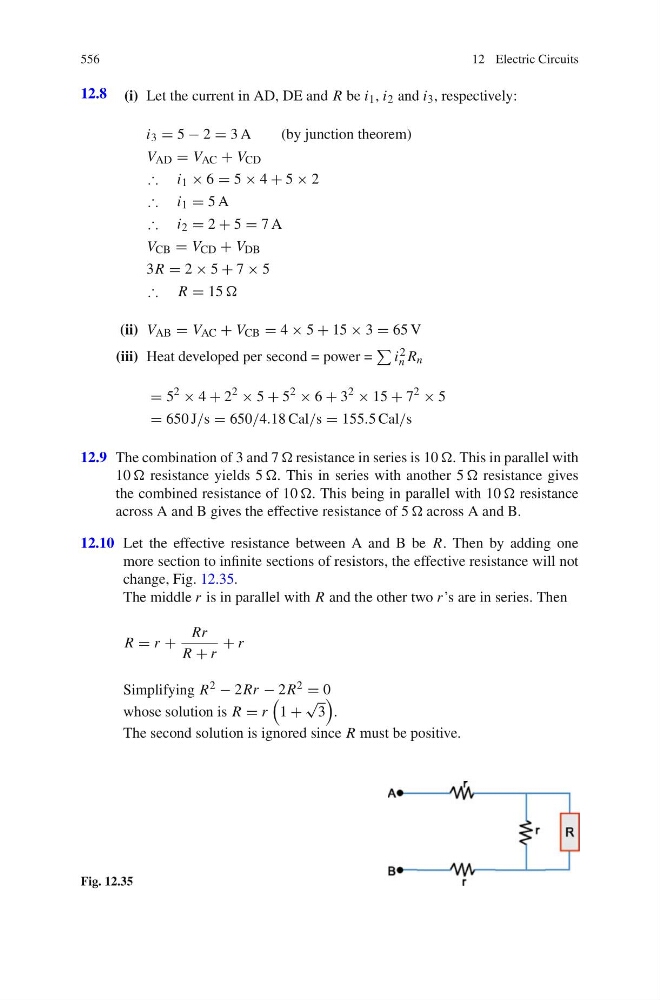
12.10 Let the effective resistance between A and B be R. Then by adding one
more section to infinite sections of resistors, the effective resistance will not
change, Fig. 12.35.
The middle r is in parallel with R and the other two r ’s are in series. Then
R = r +
Rr
R + r
+ r
Simplifying R 2 − 2Rr − 2R 2 = 0
whose solution is R = r
1 +
√
3
.
The second solution is ignored since R must be positive.
Fig. 12.35