

12.3 Solutions
555
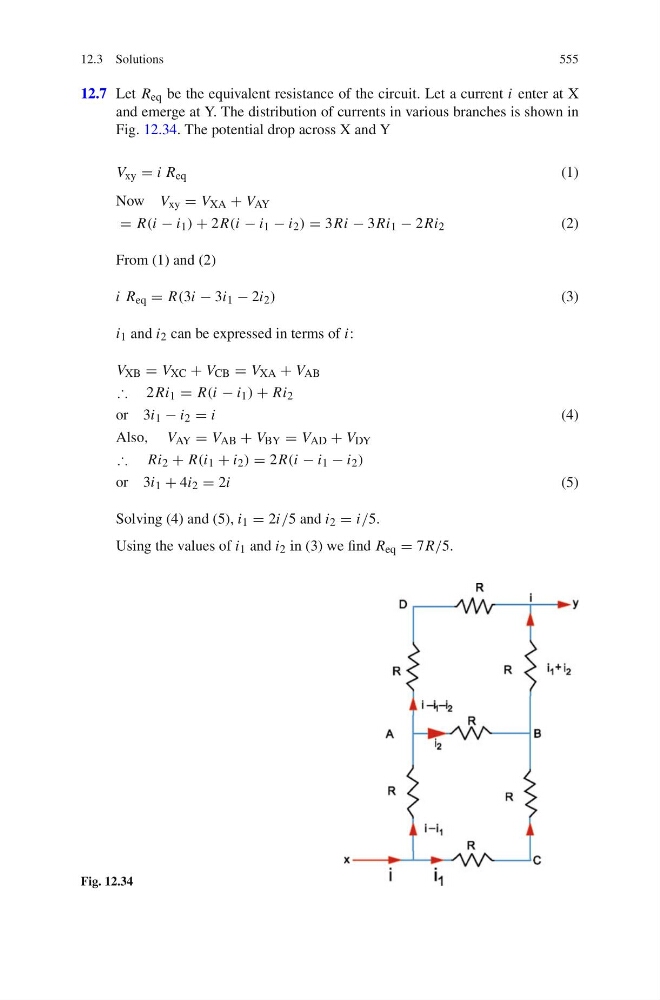
12.7 Let R eq be the equivalent resistance of the circuit. Let a current i enter at X
and emerge at Y. The distribution of currents in various branches is shown in
Fig. 12.34. The potential drop across X and Y
V xy = i R eq
(1)
Now V xy = V XA + V AY
= R(i − i 1 ) + 2R(i − i 1 − i 2 ) = 3Ri − 3Ri 1 − 2Ri 2
(2)
From (1) and (2)
i R eq = R(3i − 3i 1 − 2i 2 )
(3)
i 1 and i 2 can be expressed in terms of i:
V XB = V XC + V CB = V XA + V AB
∴ 2Ri 1 = R(i − i 1 ) + Ri 2
or 3i 1 − i 2 = i
(4)
Also, V AY = V AB + V BY = V AD + V DY
∴ Ri 2 + R(i 1 + i 2 ) = 2R(i − i 1 − i 2 )
or 3i 1 + 4i 2 = 2i
(5)
Solving (4) and (5), i 1 = 2i/5 and i 2 = i/5.
Using the values of i 1 and i 2 in (3) we find R eq = 7R/5.
Fig. 12.34