

12.3 Solutions
557
12.11 R I =
ρl
A
=
10 × 10 −6 l
π(0.05) 2 = 1.274 × 10
−3 l
R C =
ρ l
A
=
49 × 10 −6 l
π(0.05) 2 = 6.24 × 10
−3 l
In parallel arrangement
R =
R I R C
R I + R C
=
(12.739 × 62.42) × 10 −6 l 2
(12.739 + 62.42) × 10 −3 l
= 10.58 × 10
−3 l = 2
∴ l = 1890 cm = 18.9 m
12.12 R 2 = R 0 (1 + αt 2 )
R 1 = R 0 (1 + αt 1 )
∴
R 2
R 1
=
1 + αt 2
1 + αt 1
∴ α =
R 2 − R 1
R 1 (t 2 − t 1 )
=
25.7 − 20.0
20 × (100 − 25)
= 3.8 × 10
−3
/
◦ C
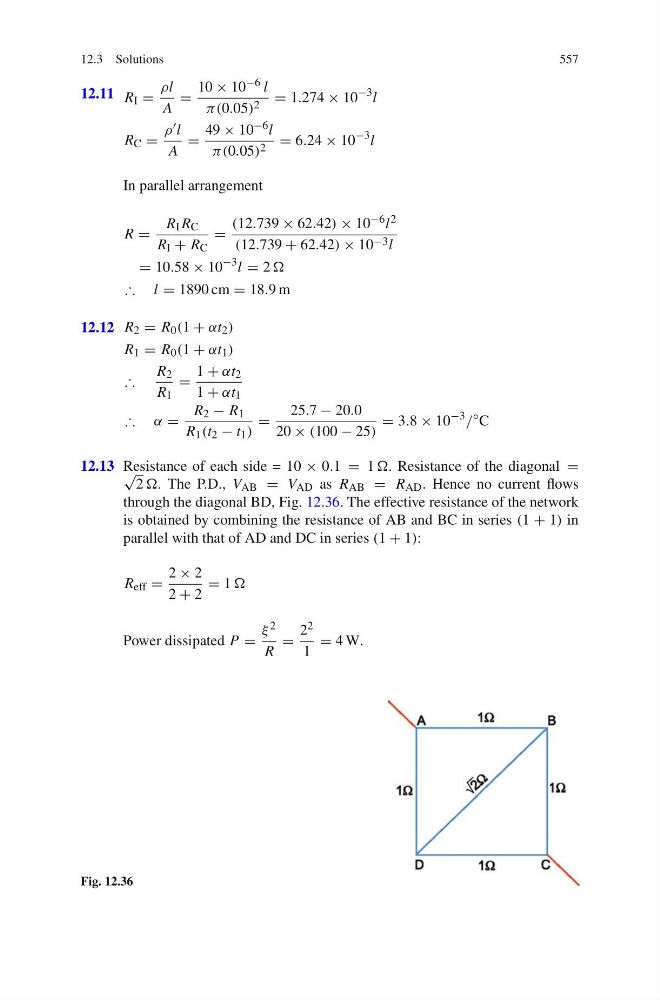
12.13 Resistance of each side = 10 × 0.1 = 1 . Resistance of the diagonal =
√
2 . The P.D., V AB = V AD as R AB = R AD . Hence no current flows
through the diagonal BD, Fig. 12.36. The effective resistance of the network
is obtained by combining the resistance of AB and BC in series (1 + 1) in
parallel with that of AD and DC in series (1 + 1):
R eff =
2 × 2
2 + 2
= 1
Power dissipated P =
ξ 2
R
=
2 2
1
= 4 W.
Fig. 12.36