

11.3 Solutions
531
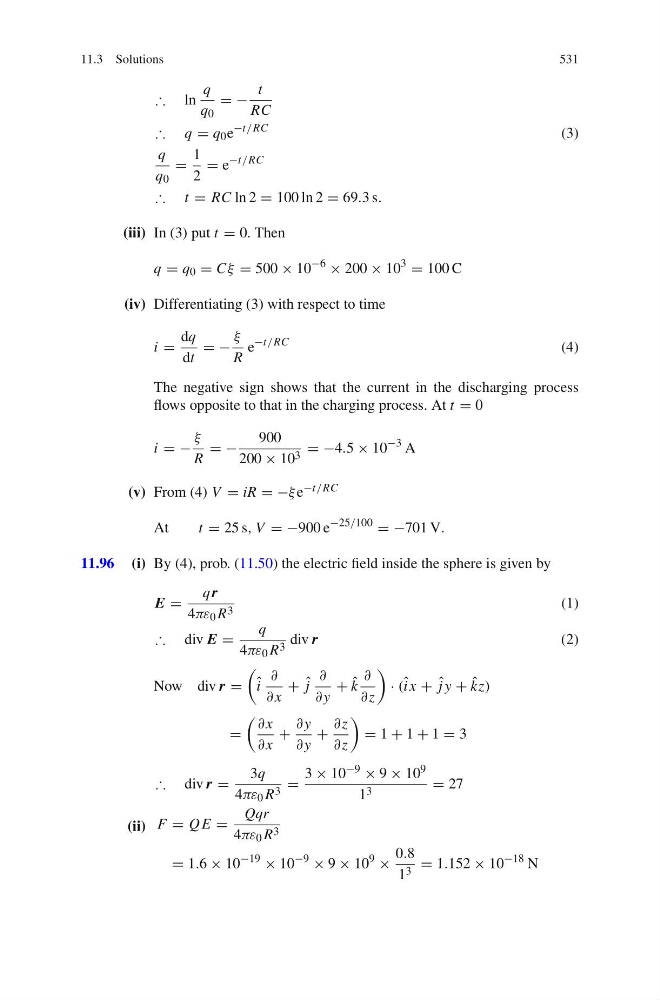
∴ ln
q
q 0
= −
t
RC
∴ q = q 0 e
−t/RC
(3)
q
q 0
=
1
2
= e
−t/RC
∴ t = RC ln 2 = 100 ln 2 = 69.3 s.
(iii) In (3) put t = 0. Then
q = q 0 = Cξ = 500 × 10
−6
× 200 × 10
3
= 100 C
(iv) Differentiating (3) with respect to time
i =
dq
dt
= −
ξ
R
e
−t/RC
(4)
The negative sign shows that the current in the discharging process
flows opposite to that in the charging process. At t = 0
i = −
ξ
R
= −
900
200 × 10 3 = −4.5 × 10
−3 A
(v) From (4) V = iR = −ξ e −t/RC
At
t = 25 s, V = −900 e
−25/100
= −701 V.
11.96 (i) By (4), prob. (11.50) the electric field inside the sphere is given by
E =
q r
4πε 0 R 3
(1)
∴ div E =
q
4πε 0 R 3 div r
(2)
Now div r =
ˆ
i
∂
∂ x
+ ˆ
j
∂
∂ y
+ ˆ
k
∂
∂z
· ( ˆ
i x + ˆ
j y + ˆ
kz)
=
∂ x
∂ x
+
∂ y
∂ y
+
∂z
∂z
= 1 + 1 + 1 = 3
∴ div r =
3q
4πε 0 R 3 =
3 × 10 −9 × 9 × 10 9
1 3
= 27
(ii) F = Q E =
Qqr
4πε 0 R 3
= 1.6 × 10
−19
× 10
−9
× 9 × 10
9
×
0.8
1 3 = 1.152 × 10
−18 N