

532
11 Electrostatics
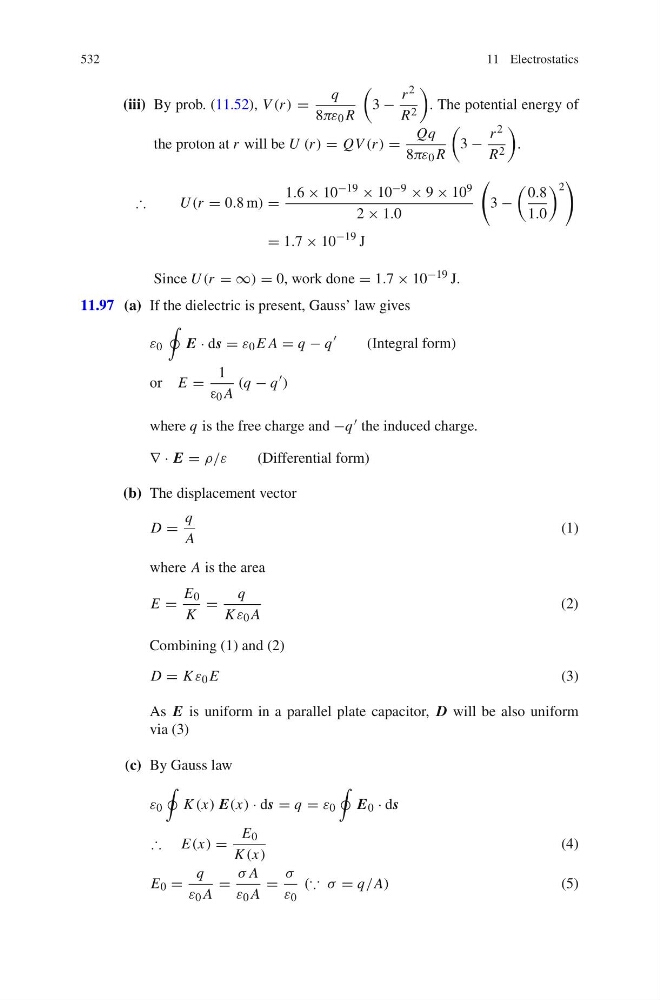
(iii) By prob. (11.52), V (r ) =
q
8πε 0 R
3 −
r 2
R 2
. The potential energy of
the proton at r will be U (r ) = QV (r ) =
Qq
8πε 0 R
3 −
r 2
R 2
.
∴
U (r = 0.8 m) =
1.6 × 10 −19 × 10 −9 × 9 × 10 9
2 × 1.0
3 −
0.8
1.0
2
= 1.7 × 10
−19 J
Since U (r = ∞) = 0, work done = 1.7 × 10 −19 J.
11.97 (a) If the dielectric is present, Gauss’ law gives
ε 0
E · ds = ε 0 E A = q − q
(Integral form)
or E =
1
ε 0 A
(q − q
)
where q is the free charge and −q the induced charge.
∇ · E = ρ/ε
(Differential form)
(b) The displacement vector
D =
q
A
(1)
where A is the area
E =
E 0
K
=
q
K ε 0 A
(2)
Combining (1) and (2)
D = K ε 0 E
(3)
As E is uniform in a parallel plate capacitor, D will be also uniform
via (3)
(c) By Gauss law
ε 0
K (x) E(x) · ds = q = ε 0
E 0 · ds
∴ E(x) =
E 0
K (x)
(4)
E 0 =
q
ε 0 A
=
σ A
ε 0 A
=
σ
ε 0
(∵ σ = q/A)
(5)
11 Electrostatics
(iii) By prob. (11.52), V (r ) =
q
8πε 0 R
3 −
r 2
R 2
. The potential energy of
the proton at r will be U (r ) = QV (r ) =
8πε 0 R
3 −
r 2
R 2
.
∴
U (r = 0.8 m) =
1.6 × 10 −19 × 10 −9 × 9 × 10 9
2 × 1.0
3 −
0.8
1.0
2
= 1.7 × 10
−19 J
Since U (r = ∞) = 0, work done = 1.7 × 10 −19 J.
11.97 (a) If the dielectric is present, Gauss’ law gives
ε 0
E · ds = ε 0 E A = q − q
(Integral form)
or E =
1
ε 0 A
(q − q
)
where q is the free charge and −q the induced charge.
∇ · E = ρ/ε
(Differential form)
(b) The displacement vector
D =
q
A
(1)
where A is the area
E =
E 0
K
=
q
K ε 0 A
(2)
Combining (1) and (2)
D = K ε 0 E
(3)
As E is uniform in a parallel plate capacitor, D will be also uniform
via (3)
(c) By Gauss law
ε 0
K (x) E(x) · ds = q = ε 0
E 0 · ds
∴ E(x) =
E 0
K (x)
(4)
E 0 =
q
ε 0 A
=
σ A
ε 0 A
=
σ
ε 0
(∵ σ = q/A)
(5)