

530
11 Electrostatics
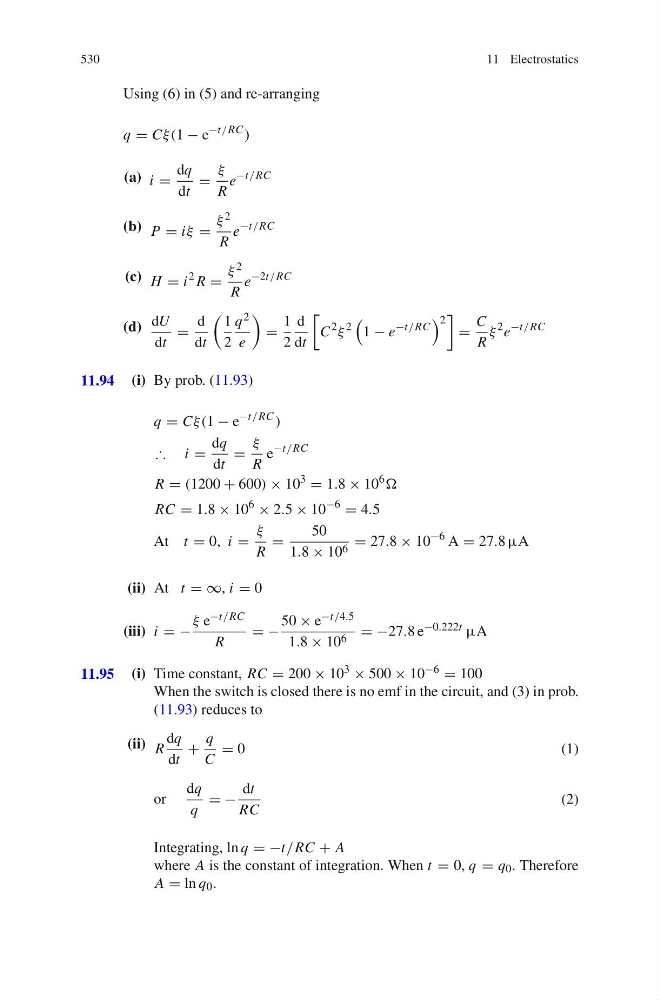
Using (6) in (5) and re-arranging
q = Cξ(1 − e
−t/RC
)
(a) i =
dq
dt
=
ξ
R
e
−t/RC
(b) P = iξ =
ξ 2
R
e
−t/RC
(c) H = i
2 R =
ξ 2
R
e
−2t/RC
(d) dU
dt
=
d
dt
1
2
q 2
e
=
1
2
d
dt
C
2
ξ
2
1 − e
−t/RC
2
=
C
R
ξ
2 e
−t/RC
11.94 (i) By prob. (11.93)
q = Cξ(1 − e
−t/RC
)
∴ i =
dq
dt
=
ξ
R
e
−t/RC
R = (1200 + 600) × 10
3
= 1.8 × 10
6
RC = 1.8 × 10
6
× 2.5 × 10
−6
= 4.5
At t = 0, i =
ξ
R
=
50
1.8 × 10 6 = 27.8 × 10
−6 A = 27.8 μA
(ii) At t = ∞, i = 0
(iii) i = −
ξ e −t/RC
R
= −
50 × e −t/4.5
1.8 × 10 6 = −27.8 e −0.222t μA
11.95 (i) Time constant, RC = 200 × 10 3 × 500 × 10 −6 = 100
When the switch is closed there is no emf in the circuit, and (3) in prob.
(11.93) reduces to
(ii) R
dq
dt
+
q
C
= 0
( 1 )
or
dq
q
= −
dt
RC
(2)
Integrating, ln q = −t/RC + A
where A is the constant of integration. When t = 0, q = q 0 . Therefore
A = ln q 0 .
11 Electrostatics
Using (6) in (5) and re-arranging
q = Cξ(1 − e
−t/RC
)
(a) i =
dq
dt
=
ξ
R
e
−t/RC
(b) P = iξ =
ξ 2
R
e
−t/RC
(c) H = i
2 R =
ξ 2
R
e
−2t/RC
(d) dU
dt
=
d
dt
1
2
q 2
e
=
1
2
d
dt
C
2
ξ
2
1 − e
−t/RC
2
=
C
R
ξ
2 e
−t/RC
11.94 (i) By prob. (11.93)
q = Cξ(1 − e
−t/RC
)
∴ i =
dq
dt
=
ξ
R
e
−t/RC
R = (1200 + 600) × 10
3
= 1.8 × 10
6
RC = 1.8 × 10
6
× 2.5 × 10
−6
= 4.5
At t = 0, i =
ξ
R
=
50
1.8 × 10 6 = 27.8 × 10
−6 A = 27.8 μA
(ii) At t = ∞, i = 0
(iii) i = −
ξ e −t/RC
R
= −
50 × e −t/4.5
1.8 × 10 6 = −27.8 e −0.222t μA
11.95 (i) Time constant, RC = 200 × 10 3 × 500 × 10 −6 = 100
When the switch is closed there is no emf in the circuit, and (3) in prob.
(11.93) reduces to
(ii) R
dq
dt
+
q
C
= 0
( 1 )
or
dq
q
= −
dt
RC
(2)
Integrating, ln q = −t/RC + A
where A is the constant of integration. When t = 0, q = q 0 . Therefore
A = ln q 0 .