

490
11 Electrostatics
F
= q E + mg = 2 mg
Acceleration a =
F
m
= 2g = 2 × 9.8 = 19.6 m/s
2
11.15 Let q be the charge on each body. Electric force = gravitational force
q 2
4πε 0 r 2 =
G Mm
r 2
q =
4πε 0 GMm
=
6.67 × 10 −11 × 6 × 10 24 × 7.4 × 10 22
9 × 10 9
1/2
= 5.736 × 10
13 C
11.16 Energy W = qV
q =
W
V
=
10 −5
5 × 10 6 = 2 × 10
−12 C
Number of electrons flowed out =
q
e
=
2 × 10 −12
1.6 × 10 −19 = 1.25 × 10 7
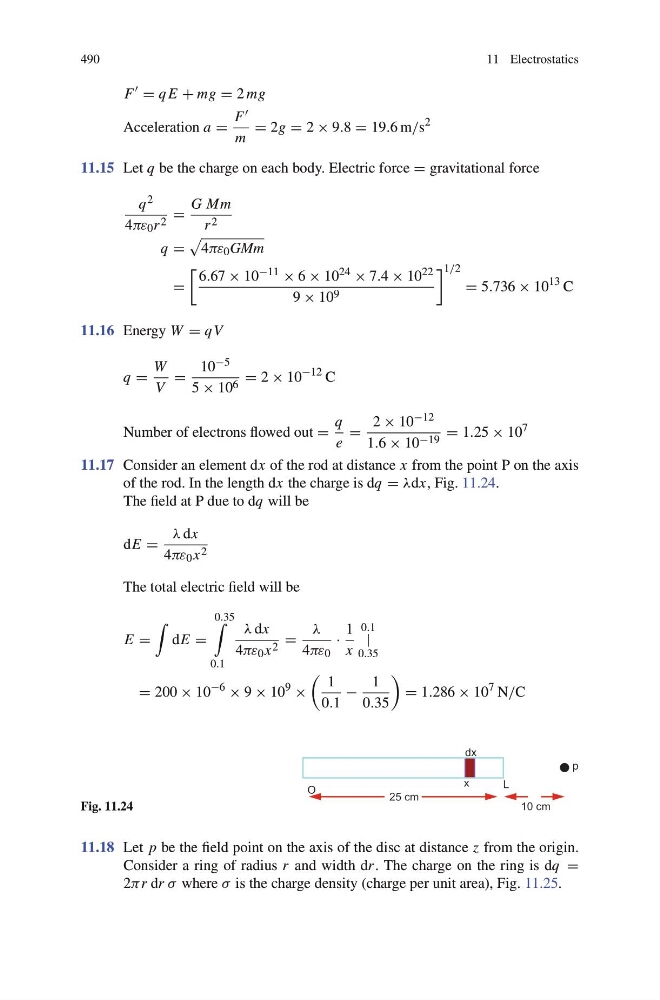
11.17 Consider an element dx of the rod at distance x from the point P on the axis
of the rod. In the length dx the charge is dq = λdx, Fig. 11.24.
The field at P due to dq will be
dE =
λ dx
4πε 0 x 2
The total electric field will be
E =
dE =
0.35
0.1
λ dx
4πε 0 x 2 =
λ
4πε 0
·
1
x
0.1
|
0.35
= 200 × 10
−6
× 9 × 10
9
×
1
0.1
−
1
0.35
= 1.286 × 10
7 N/C
Fig. 11.24
11.18 Let p be the field point on the axis of the disc at distance z from the origin.
Consider a ring of radius r and width dr . The charge on the ring is dq =
2πr dr σ where σ is the charge density (charge per unit area), Fig. 11.25.
11 Electrostatics
F
= q E + mg = 2 mg
Acceleration a =
F
m
= 2g = 2 × 9.8 = 19.6 m/s
2
11.15 Let q be the charge on each body. Electric force = gravitational force
q 2
4πε 0 r 2 =
G Mm
r 2
q =
4πε 0 GMm
=
6.67 × 10 −11 × 6 × 10 24 × 7.4 × 10 22
9 × 10 9
1/2
= 5.736 × 10
13 C
11.16 Energy W = qV
q =
W
V
=
10 −5
5 × 10 6 = 2 × 10
−12 C
Number of electrons flowed out =
q
e
=
2 × 10 −12
1.6 × 10 −19 = 1.25 × 10 7
11.17 Consider an element dx of the rod at distance x from the point P on the axis
of the rod. In the length dx the charge is dq = λdx, Fig. 11.24.
The field at P due to dq will be
dE =
λ dx
4πε 0 x 2
The total electric field will be
E =
dE =
0.35
0.1
λ dx
4πε 0 x 2 =
λ
4πε 0
·
1
x
0.1
|
0.35
= 200 × 10
−6
× 9 × 10
9
×
1
0.1
−
1
0.35
= 1.286 × 10
7 N/C
Fig. 11.24
11.18 Let p be the field point on the axis of the disc at distance z from the origin.
Consider a ring of radius r and width dr . The charge on the ring is dq =
2πr dr σ where σ is the charge density (charge per unit area), Fig. 11.25.