

11.3 Solutions
489
Work done in carrying the charge q from C to B will be
W CB = U (B) − U (C) =
qq 1
4πε 0
1
AB
−
1
AC
= 5 × 10
−9
× 6 × 10
−8
× 9 × 10
9
1
0.1
−
1
(0.1)
√
2
= 7.9 × 10
−6 J
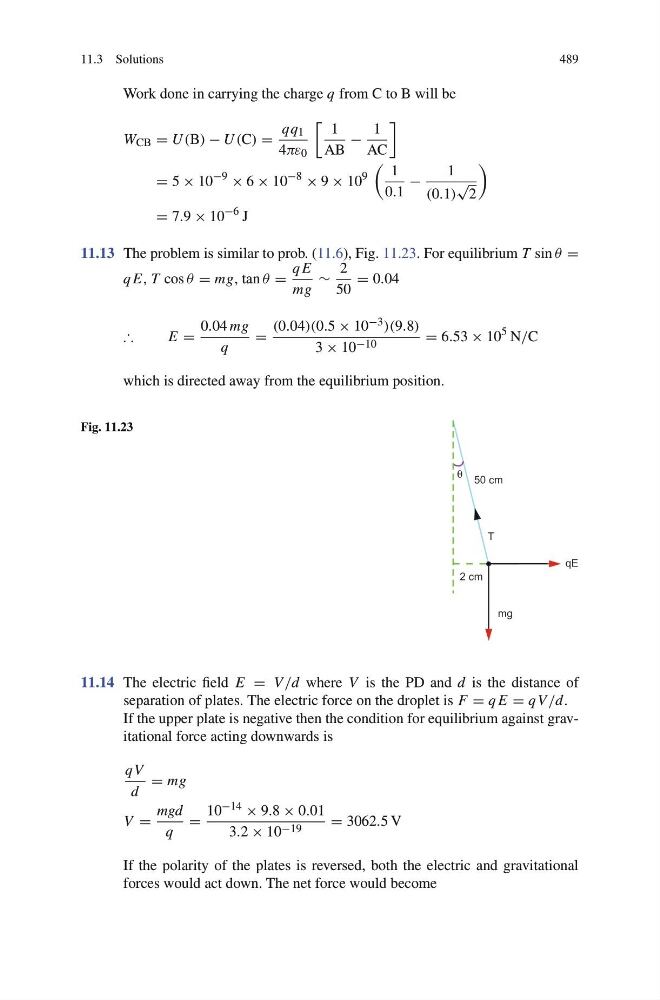
11.13 The problem is similar to prob. (11.6), Fig. 11.23. For equilibrium T sin θ =
q E, T cos θ = mg, tan θ =
q E
mg
∼
2
50
= 0.04
∴
E =
0.04 mg
q
=
(0.04)(0.5 × 10 −3 )(9.8)
3 × 10 −10
= 6.53 × 10
5 N/C
which is directed away from the equilibrium position.
Fig. 11.23
11.14 The electric field E = V /d where V is the PD and d is the distance of
separation of plates. The electric force on the droplet is F = q E = qV /d.
If the upper plate is negative then the condition for equilibrium against gravitational force acting downwards is
qV
d
= mg
V =
mgd
q
=
10 −14 × 9.8 × 0.01
3.2 × 10 −19
= 3062.5 V
If the polarity of the plates is reversed, both the electric and gravitational
forces would act down. The net force would become
489
Work done in carrying the charge q from C to B will be
W CB = U (B) − U (C) =
qq 1
4πε 0
1
AB
−
1
AC
= 5 × 10
−9
× 6 × 10
−8
× 9 × 10
9
1
0.1
−
1
(0.1)
√
2
= 7.9 × 10
−6 J
11.13 The problem is similar to prob. (11.6), Fig. 11.23. For equilibrium T sin θ =
q E, T cos θ = mg, tan θ =
q E
mg
∼
2
50
= 0.04
∴
E =
0.04 mg
q
=
(0.04)(0.5 × 10 −3 )(9.8)
3 × 10 −10
= 6.53 × 10
5 N/C
which is directed away from the equilibrium position.
Fig. 11.23
11.14 The electric field E = V /d where V is the PD and d is the distance of
separation of plates. The electric force on the droplet is F = q E = qV /d.
If the upper plate is negative then the condition for equilibrium against gravitational force acting downwards is
qV
d
= mg
V =
mgd
q
=
10 −14 × 9.8 × 0.01
3.2 × 10 −19
= 3062.5 V
If the polarity of the plates is reversed, both the electric and gravitational
forces would act down. The net force would become