

11.3 Solutions
491
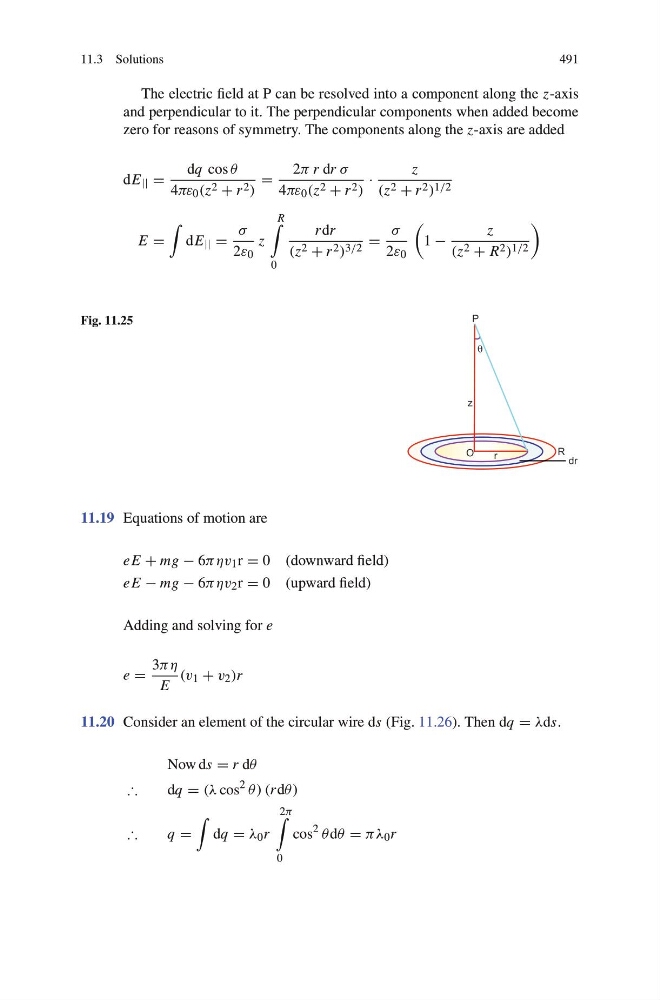
The electric field at P can be resolved into a component along the z-axis
and perpendicular to it. The perpendicular components when added become
zero for reasons of symmetry. The components along the z-axis are added
dE || =
dq cos θ
4πε 0 (z 2 + r 2 )
=
2π r dr σ
4πε 0 (z 2 + r 2 )
·
z
(z 2 + r 2 ) 1/2
E =
dE || =
σ
2ε 0
z
R
0
r dr
(z 2 + r 2 ) 3/2 =
σ
2ε 0
1 −
z
(z 2 + R 2 ) 1/2
Fig. 11.25
11.19 Equations of motion are
eE + mg − 6πηv 1 r = 0 (downward field)
eE − mg − 6πηv 2 r = 0 (upward field)
Adding and solving for e
e =
3πη
E
(v 1 + v 2 )r
11.20 Consider an element of the circular wire ds (Fig. 11.26). Then dq = λds.
Now ds = r dθ
∴
dq = (λ cos
2
θ) (r dθ)
∴
q =
dq = λ 0 r
2π
0
cos
2
θ dθ = πλ 0 r
491
The electric field at P can be resolved into a component along the z-axis
and perpendicular to it. The perpendicular components when added become
zero for reasons of symmetry. The components along the z-axis are added
dE || =
dq cos θ
4πε 0 (z 2 + r 2 )
=
2π r dr σ
4πε 0 (z 2 + r 2 )
·
z
(z 2 + r 2 ) 1/2
E =
dE || =
σ
2ε 0
z
R
0
r dr
(z 2 + r 2 ) 3/2 =
σ
2ε 0
1 −
z
(z 2 + R 2 ) 1/2
Fig. 11.25
11.19 Equations of motion are
eE + mg − 6πηv 1 r = 0 (downward field)
eE − mg − 6πηv 2 r = 0 (upward field)
Adding and solving for e
e =
3πη
E
(v 1 + v 2 )r
11.20 Consider an element of the circular wire ds (Fig. 11.26). Then dq = λds.
Now ds = r dθ
∴
dq = (λ cos
2
θ) (r dθ)
∴
q =
dq = λ 0 r
2π
0
cos
2
θ dθ = πλ 0 r