

430
10 Heat and Matter
10.3.2 Thermal Expansion
10.9 Let the length of the bars be L 0 , each at 0 ◦ C when they are straight. With the
rise of temperature T , their lengths will be (Fig. 10.2)
L 1 = θ R 1 = L 0 (1 + α 1 T )
(1)
L 2 = θ R 2 = L 0 (1 + α 2 T )
(2)
Subtracting (2) from (1)
θ(R 1 − R 2 ) = θ d = (α 1 − α 2 )L 0 T
(3)
∵ R 1 − R 2 = d
Adding (1) and (2)
θ(R 1 + R 2 ) = 2L 0 + (α 1 + α 2 )L 0 T 2L 0
(4)
∵ (α 1 + α 2 ))T << 2
R =
R 1 + R 2
2
=
L 0
θ
=
d
(α 1 − α 2 ))T
(5)
where we have used (3).
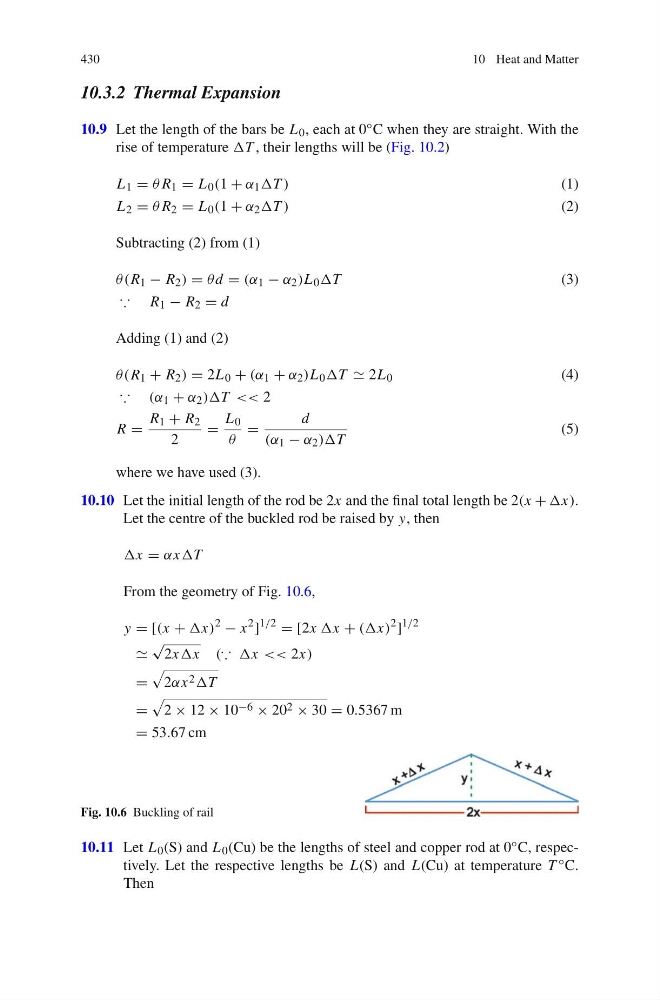
10.10 Let the initial length of the rod be 2x and the final total length be 2(x + x).
Let the centre of the buckled rod be raised by y, then
x = αxT
From the geometry of Fig. 10.6,
y = [(x + x)
2
− x
2
]
1/2
= [2x x + ((x)
2
]
1/2
√
2xx (∵ x << 2x)
=
2αx 2 T
=
2 × 12 × 10 −6 × 20 2 × 30 = 0.5367 m
= 53.67 cm
Fig. 10.6 Buckling of rail
10.11 Let L 0 (S) and L 0 (Cu) be the lengths of steel and copper rod at 0 ◦ C, respectively. Let the respective lengths be L(S) and L(Cu) at temperature T ◦ C.
Then
10 Heat and Matter
10.3.2 Thermal Expansion
10.9 Let the length of the bars be L 0 , each at 0 ◦ C when they are straight. With the
rise of temperature T , their lengths will be (Fig. 10.2)
L 1 = θ R 1 = L 0 (1 + α 1 T )
(1)
L 2 = θ R 2 = L 0 (1 + α 2 T )
(2)
Subtracting (2) from (1)
θ(R 1 − R 2 ) = θ d = (α 1 − α 2 )L 0 T
(3)
∵ R 1 − R 2 = d
Adding (1) and (2)
θ(R 1 + R 2 ) = 2L 0 + (α 1 + α 2 )L 0 T 2L 0
(4)
∵ (α 1 + α 2 ))T << 2
R =
R 1 + R 2
2
=
L 0
θ
=
d
(α 1 − α 2 ))T
(5)
where we have used (3).
10.10 Let the initial length of the rod be 2x and the final total length be 2(x + x).
Let the centre of the buckled rod be raised by y, then
x = αxT
From the geometry of Fig. 10.6,
y = [(x + x)
2
− x
2
]
1/2
= [2x x + ((x)
2
]
1/2
√
2xx (∵ x << 2x)
=
2αx 2 T
=
2 × 12 × 10 −6 × 20 2 × 30 = 0.5367 m
= 53.67 cm
Fig. 10.6 Buckling of rail
10.11 Let L 0 (S) and L 0 (Cu) be the lengths of steel and copper rod at 0 ◦ C, respectively. Let the respective lengths be L(S) and L(Cu) at temperature T ◦ C.
Then