

10.3 Solutions
431
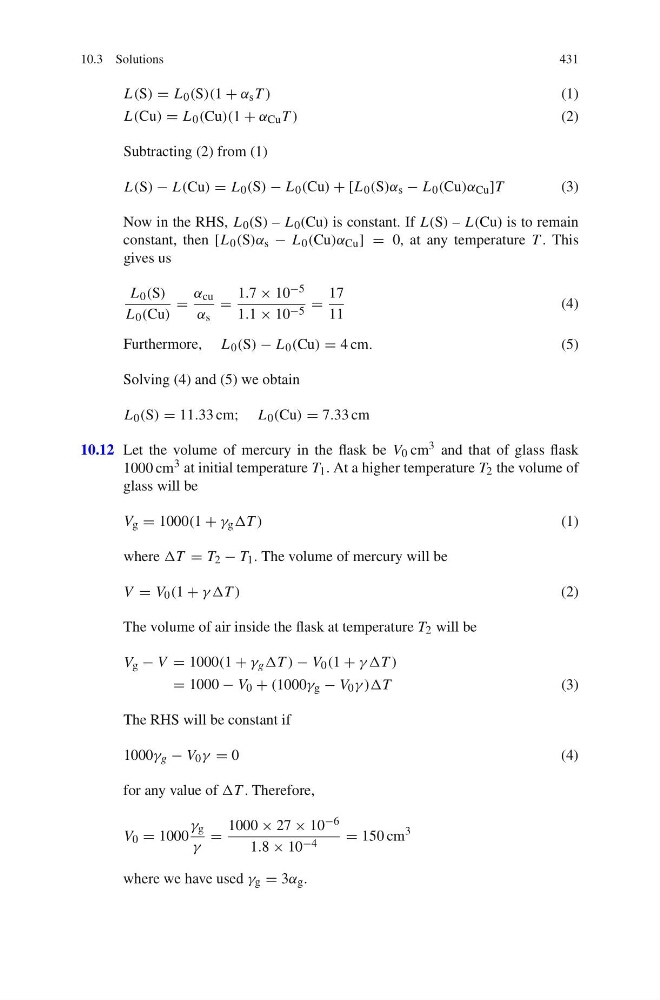
L(S) = L 0 (S)(1 + α s T )
(1)
L(Cu) = L 0 (Cu)(1 + α Cu T )
(2)
Subtracting (2) from (1)
L(S) − L(Cu) = L 0 (S) − L 0 (Cu) + [L 0 (S)α s − L 0 (Cu)α Cu ]T
(3)
Now in the RHS, L 0 (S) – L 0 (Cu) is constant. If L(S) – L(Cu) is to remain
constant, then [L 0 (S)α s − L 0 (Cu)α Cu ] = 0, at any temperature T . This
gives us
L 0 (S)
L 0 (Cu)
=
α cu
α s
=
1.7 × 10 −5
1.1 × 10 −5 =
17
11
(4)
Furthermore, L 0 (S) − L 0 (Cu) = 4 cm.
(5)
Solving (4) and (5) we obtain
L 0 (S) = 11.33 cm; L 0 (Cu) = 7.33 cm
10.12 Let the volume of mercury in the flask be V 0 cm 3 and that of glass flask
1000 cm 3 at initial temperature T 1 . At a higher temperature T 2 the volume of
glass will be
V g = 1000(1 + γ g T )
(1)
where T = T 2 − T 1 . The volume of mercury will be
V = V 0 (1 + γ γT )
(2)
The volume of air inside the flask at temperature T 2 will be
V g − V = 1000(1 + γ g T ) − V 0 (1 + γ γT )
= 1000 − V 0 + (1000γ g − V 0 γ ))T
(3)
The RHS will be constant if
1000γ g − V 0 γ = 0
( 4 )
for any value of T . Therefore,
V 0 = 1000
γ g
γ
=
1000 × 27 × 10 −6
1.8 × 10 −4
= 150 cm
3
where we have used γ g = 3α g .
431
L(S) = L 0 (S)(1 + α s T )
(1)
L(Cu) = L 0 (Cu)(1 + α Cu T )
(2)
Subtracting (2) from (1)
L(S) − L(Cu) = L 0 (S) − L 0 (Cu) + [L 0 (S)α s − L 0 (Cu)α Cu ]T
(3)
Now in the RHS, L 0 (S) – L 0 (Cu) is constant. If L(S) – L(Cu) is to remain
constant, then [L 0 (S)α s − L 0 (Cu)α Cu ] = 0, at any temperature T . This
gives us
L 0 (S)
L 0 (Cu)
=
α cu
α s
=
1.7 × 10 −5
1.1 × 10 −5 =
17
11
(4)
Furthermore, L 0 (S) − L 0 (Cu) = 4 cm.
(5)
Solving (4) and (5) we obtain
L 0 (S) = 11.33 cm; L 0 (Cu) = 7.33 cm
10.12 Let the volume of mercury in the flask be V 0 cm 3 and that of glass flask
1000 cm 3 at initial temperature T 1 . At a higher temperature T 2 the volume of
glass will be
V g = 1000(1 + γ g T )
(1)
where T = T 2 − T 1 . The volume of mercury will be
V = V 0 (1 + γ γT )
(2)
The volume of air inside the flask at temperature T 2 will be
V g − V = 1000(1 + γ g T ) − V 0 (1 + γ γT )
= 1000 − V 0 + (1000γ g − V 0 γ ))T
(3)
The RHS will be constant if
1000γ g − V 0 γ = 0
( 4 )
for any value of T . Therefore,
V 0 = 1000
γ g
γ
=
1000 × 27 × 10 −6
1.8 × 10 −4
= 150 cm
3
where we have used γ g = 3α g .