

10.3 Solutions
429
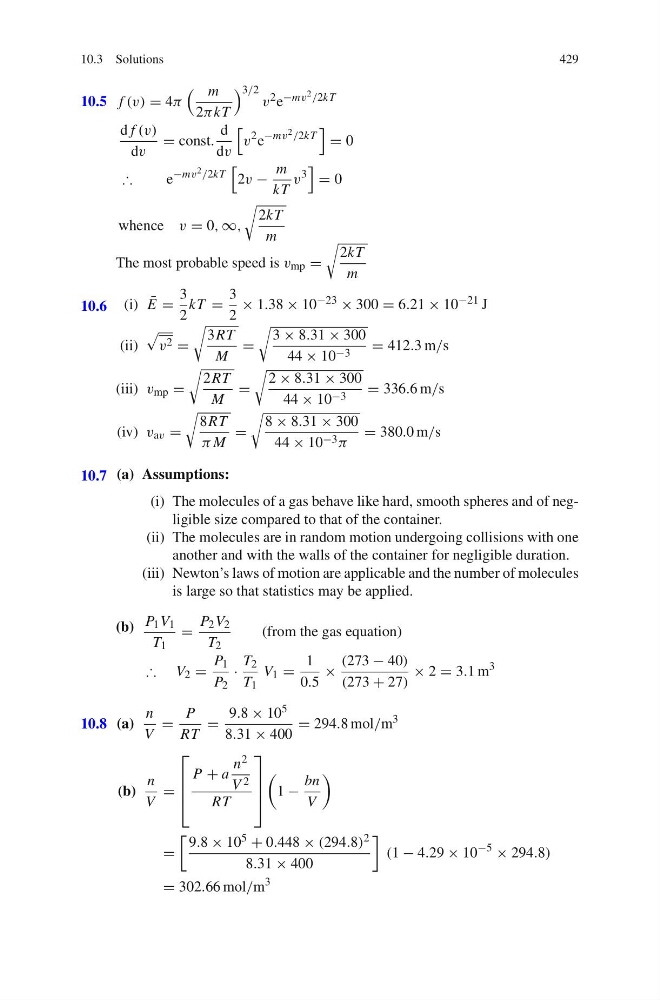
10.5 f (v) = 4π
m
2π kT
3/2 v 2 e −mv 2 /2kT
d f (v)
dv
= const.
d
dv
v
2 e
−mv 2 /2kT
= 0
∴
e
−mv 2 /2kT
2v −
m
kT
v
3
= 0
whence v = 0, ∞,
2kT
m
The most probable speed is v mp =
2kT
m
10.6 (i) ¯
E =
3
2
kT =
3
2
× 1.38 × 10 −23 × 300 = 6.21 × 10 −21 J
(ii)
v 2 =
3RT
M
=
3 × 8.31 × 300
44 × 10 −3 = 412.3 m/s
(iii) v mp =
2RT
M
=
2 × 8.31 × 300
44 × 10 −3 = 336.6 m/s
(iv) v av =
8RT
π M
=
8 × 8.31 × 300
44 × 10 −3 π
= 380.0 m/s
10.7 (a) Assumptions:
(i) The molecules of a gas behave like hard, smooth spheres and of negligible size compared to that of the container.
(ii) The molecules are in random motion undergoing collisions with one
another and with the walls of the container for negligible duration.
(iii) Newton’s laws of motion are applicable and the number of molecules
is large so that statistics may be applied.
(b) P 1 V 1
T 1
=
P 2 V 2
T 2
(from the gas equation)
∴ V 2 =
P 1
P 2
·
T 2
T 1
V 1 =
1
0.5
×
(273 − 40)
(273 + 27)
× 2 = 3.1 m
3
10.8 (a)
n
V
=
P
RT
=
9.8 × 10 5
8.31 × 400
= 294.8 mol/m
3
(b)
n
V
=
⎡
⎢
⎢
⎣
P + a
n 2
V 2
RT
⎤
⎥
⎥
⎦
1 −
bn
V
=
9.8 × 10 5 + 0.448 × (294.8) 2
8.31 × 400
(1 − 4.29 × 10
−5
× 294.8)
= 302.66 mol/m
3
429
10.5 f (v) = 4π
m
2π kT
3/2 v 2 e −mv 2 /2kT
d f (v)
dv
= const.
d
dv
v
2 e
−mv 2 /2kT
= 0
∴
e
−mv 2 /2kT
2v −
m
kT
v
3
= 0
whence v = 0, ∞,
2kT
m
The most probable speed is v mp =
2kT
m
10.6 (i) ¯
E =
3
2
kT =
3
2
× 1.38 × 10 −23 × 300 = 6.21 × 10 −21 J
(ii)
v 2 =
3RT
M
=
3 × 8.31 × 300
44 × 10 −3 = 412.3 m/s
(iii) v mp =
2RT
M
=
2 × 8.31 × 300
44 × 10 −3 = 336.6 m/s
(iv) v av =
8RT
π M
=
8 × 8.31 × 300
44 × 10 −3 π
= 380.0 m/s
10.7 (a) Assumptions:
(i) The molecules of a gas behave like hard, smooth spheres and of negligible size compared to that of the container.
(ii) The molecules are in random motion undergoing collisions with one
another and with the walls of the container for negligible duration.
(iii) Newton’s laws of motion are applicable and the number of molecules
is large so that statistics may be applied.
(b) P 1 V 1
T 1
=
P 2 V 2
T 2
(from the gas equation)
∴ V 2 =
P 1
P 2
·
T 2
T 1
V 1 =
1
0.5
×
(273 − 40)
(273 + 27)
× 2 = 3.1 m
3
10.8 (a)
n
V
=
P
RT
=
9.8 × 10 5
8.31 × 400
= 294.8 mol/m
3
(b)
n
V
=
⎡
⎢
⎢
⎣
P + a
n 2
V 2
RT
⎤
⎥
⎥
⎦
1 −
bn
V
=
9.8 × 10 5 + 0.448 × (294.8) 2
8.31 × 400
(1 − 4.29 × 10
−5
× 294.8)
= 302.66 mol/m
3