

416
10 Heat and Matter
(b) A weather balloon is loosely filled with 2 m 3 of helium at 1 atm. and
27 ◦ C. The balloon is then released, and by the time it has reached an
elevation of 7000 m the pressure has dropped to 0.5 atm. and the balloon
has expanded. If the temperature at this elevation is −48 ◦ C, what is the
new volume of the balloon?
10.8 van der Waal’s equation can be written in terms of moles per volume as
n
V
=
⎛
⎜
⎜
⎝
p + a
n 2
V 2
RT
⎞
⎟
⎟
⎠
1 − b
n
V
The van der Waal’s parameters for hydrogen sulphide gas (H 2 S) are a =
0.448 J m 3 /mol
2 and b = 4.29 × 10 −5 m 3 /mol. Determine an estimate of
the number of moles per volume of H 2 S gas at 127 ◦ C and a pressure of
9.80 × 10 5 Pa as follows:
(a) Calculate as a first approximation using the ideal gas equation,
n
V
=
p
RT
.
(b) Substitute this first approximation into the right-hand side of the equation
derived in part (a) to find a new approximation of
n
V
(on the left-hand
side) that takes into account real gas effects.
10.2.2 Thermal Expansion
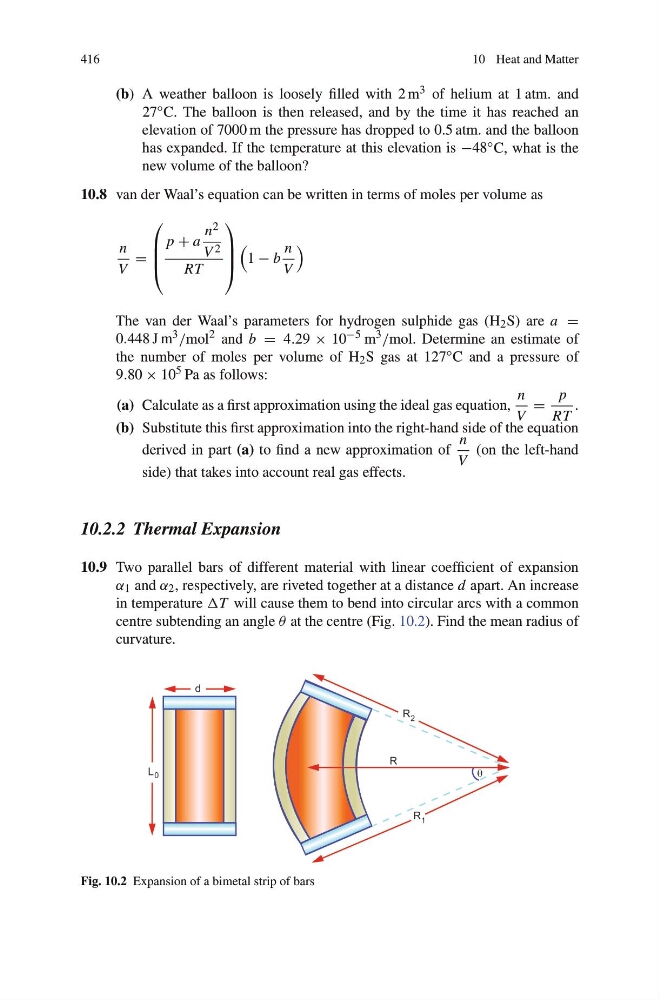
10.9 Two parallel bars of different material with linear coefficient of expansion
α 1 and α 2 , respectively, are riveted together at a distance d apart. An increase
in temperature T will cause them to bend into circular arcs with a common
centre subtending an angle θ at the centre (Fig. 10.2). Find the mean radius of
curvature.
Fig. 10.2 Expansion of a bimetal strip of bars
10 Heat and Matter
(b) A weather balloon is loosely filled with 2 m 3 of helium at 1 atm. and
27 ◦ C. The balloon is then released, and by the time it has reached an
elevation of 7000 m the pressure has dropped to 0.5 atm. and the balloon
has expanded. If the temperature at this elevation is −48 ◦ C, what is the
new volume of the balloon?
10.8 van der Waal’s equation can be written in terms of moles per volume as
n
V
=
⎛
⎜
⎜
⎝
p + a
n 2
V 2
RT
⎞
⎟
⎟
⎠
1 − b
n
V
The van der Waal’s parameters for hydrogen sulphide gas (H 2 S) are a =
0.448 J m 3 /mol
2 and b = 4.29 × 10 −5 m 3 /mol. Determine an estimate of
the number of moles per volume of H 2 S gas at 127 ◦ C and a pressure of
9.80 × 10 5 Pa as follows:
(a) Calculate as a first approximation using the ideal gas equation,
n
V
=
p
RT
.
(b) Substitute this first approximation into the right-hand side of the equation
derived in part (a) to find a new approximation of
n
V
(on the left-hand
side) that takes into account real gas effects.
10.2.2 Thermal Expansion
10.9 Two parallel bars of different material with linear coefficient of expansion
α 1 and α 2 , respectively, are riveted together at a distance d apart. An increase
in temperature T will cause them to bend into circular arcs with a common
centre subtending an angle θ at the centre (Fig. 10.2). Find the mean radius of
curvature.
Fig. 10.2 Expansion of a bimetal strip of bars