

10.2 Problems
415
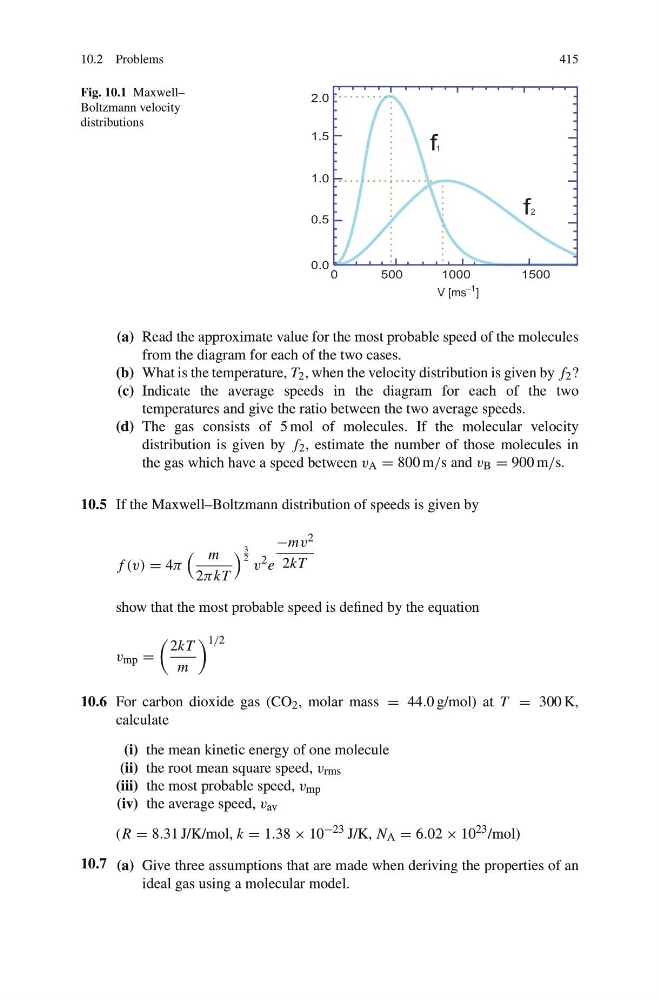
Fig. 10.1 Maxwell–
Boltzmann velocity
distributions
(a) Read the approximate value for the most probable speed of the molecules
from the diagram for each of the two cases.
(b) What is the temperature, T 2 , when the velocity distribution is given by f 2 ?
(c) Indicate the average speeds in the diagram for each of the two
temperatures and give the ratio between the two average speeds.
(d) The gas consists of 5 mol of molecules. If the molecular velocity
distribution is given by f 2 , estimate the number of those molecules in
the gas which have a speed between v A = 800 m/s and v B = 900 m/s.
10.5 If the Maxwell–Boltzmann distribution of speeds is given by
f (v) = 4π
m
2π kT
3
2 v
2 e
−mv 2
2kT
show that the most probable speed is defined by the equation
v mp =
2kT
m
1/2
10.6 For carbon dioxide gas (CO 2 , molar mass = 44.0 g/mol) at T = 300 K,
calculate
(i) the mean kinetic energy of one molecule
(ii) the root mean square speed, v rms
(iii) the most probable speed, v mp
(iv) the average speed, v av
(R = 8.31 J/K/mol, k = 1.38 × 10 −23 J/K, N A = 6.02 × 10 23 /mol)
10.7 (a) Give three assumptions that are made when deriving the properties of an
ideal gas using a molecular model.
415
Fig. 10.1 Maxwell–
Boltzmann velocity
distributions
(a) Read the approximate value for the most probable speed of the molecules
from the diagram for each of the two cases.
(b) What is the temperature, T 2 , when the velocity distribution is given by f 2 ?
(c) Indicate the average speeds in the diagram for each of the two
temperatures and give the ratio between the two average speeds.
(d) The gas consists of 5 mol of molecules. If the molecular velocity
distribution is given by f 2 , estimate the number of those molecules in
the gas which have a speed between v A = 800 m/s and v B = 900 m/s.
10.5 If the Maxwell–Boltzmann distribution of speeds is given by
f (v) = 4π
m
2π kT
3
2 v
2 e
−mv 2
2kT
show that the most probable speed is defined by the equation
v mp =
2kT
m
1/2
10.6 For carbon dioxide gas (CO 2 , molar mass = 44.0 g/mol) at T = 300 K,
calculate
(i) the mean kinetic energy of one molecule
(ii) the root mean square speed, v rms
(iii) the most probable speed, v mp
(iv) the average speed, v av
(R = 8.31 J/K/mol, k = 1.38 × 10 −23 J/K, N A = 6.02 × 10 23 /mol)
10.7 (a) Give three assumptions that are made when deriving the properties of an
ideal gas using a molecular model.