

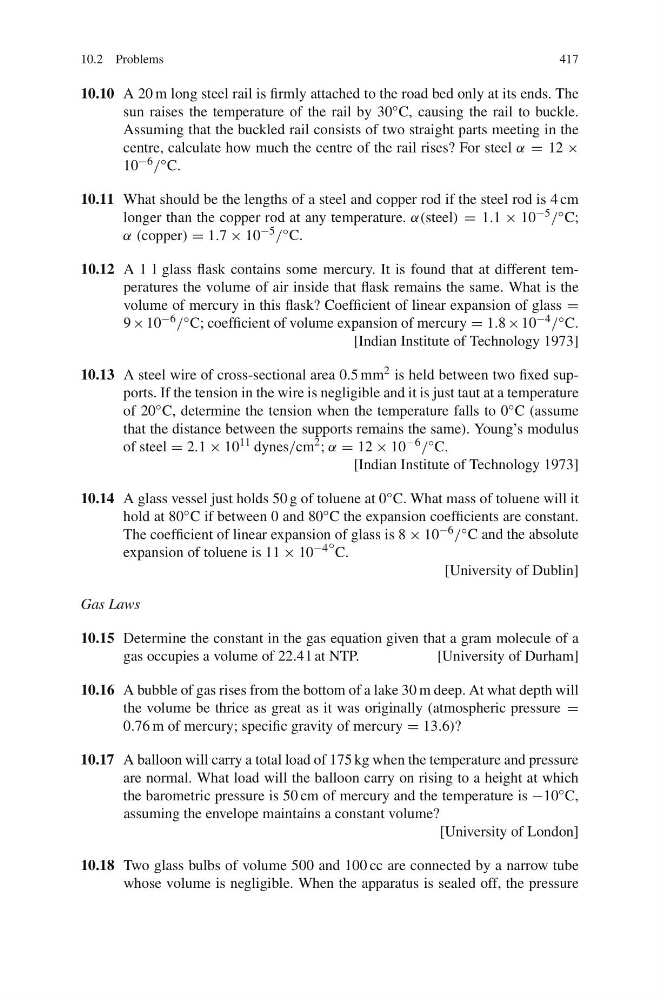
10.2 Problems
417
10.10 A 20 m long steel rail is firmly attached to the road bed only at its ends. The
sun raises the temperature of the rail by 30 ◦ C, causing the rail to buckle.
Assuming that the buckled rail consists of two straight parts meeting in the
centre, calculate how much the centre of the rail rises? For steel α = 12 ×
10 −6 / ◦ C.
10.11 What should be the lengths of a steel and copper rod if the steel rod is 4 cm
longer than the copper rod at any temperature. α(steel) = 1.1 × 10 −5 / ◦ C;
α (copper) = 1.7 × 10 −5 / ◦ C.
10.12 A 1 l glass flask contains some mercury. It is found that at different temperatures the volume of air inside that flask remains the same. What is the
volume of mercury in this flask? Coefficient of linear expansion of glass =
9 × 10 −6 / ◦ C; coefficient of volume expansion of mercury = 1.8 × 10 −4 / ◦ C.
[Indian Institute of Technology 1973]
10.13 A steel wire of cross-sectional area 0.5 mm 2 is held between two fixed supports. If the tension in the wire is negligible and it is just taut at a temperature
of 20 ◦ C, determine the tension when the temperature falls to 0 ◦ C (assume
that the distance between the supports remains the same). Young’s modulus
of steel = 2.1 × 10 11 dynes/cm
2 ; α = 12 × 10 −6 / ◦ C.
[Indian Institute of Technology 1973]
10.14 A glass vessel just holds 50 g of toluene at 0 ◦ C. What mass of toluene will it
hold at 80 ◦ C if between 0 and 80 ◦ C the expansion coefficients are constant.
The coefficient of linear expansion of glass is 8 × 10 −6 / ◦ C and the absolute
expansion of toluene is 11 × 10 −4 ◦ C.
[University of Dublin]
Gas Laws
10.15 Determine the constant in the gas equation given that a gram molecule of a
gas occupies a volume of 22.4 l at NTP.
[University of Durham]
10.16 A bubble of gas rises from the bottom of a lake 30 m deep. At what depth will
the volume be thrice as great as it was originally (atmospheric pressure =
0.76 m of mercury; specific gravity of mercury = 13.6)?
10.17 A balloon will carry a total load of 175 kg when the temperature and pressure
are normal. What load will the balloon carry on rising to a height at which
the barometric pressure is 50 cm of mercury and the temperature is −10 ◦ C,
assuming the envelope maintains a constant volume?
[University of London]
10.18 Two glass bulbs of volume 500 and 100 cc are connected by a narrow tube
whose volume is negligible. When the apparatus is sealed off, the pressure
417
10.10 A 20 m long steel rail is firmly attached to the road bed only at its ends. The
sun raises the temperature of the rail by 30 ◦ C, causing the rail to buckle.
Assuming that the buckled rail consists of two straight parts meeting in the
centre, calculate how much the centre of the rail rises? For steel α = 12 ×
10 −6 / ◦ C.
10.11 What should be the lengths of a steel and copper rod if the steel rod is 4 cm
longer than the copper rod at any temperature. α(steel) = 1.1 × 10 −5 / ◦ C;
α (copper) = 1.7 × 10 −5 / ◦ C.
10.12 A 1 l glass flask contains some mercury. It is found that at different temperatures the volume of air inside that flask remains the same. What is the
volume of mercury in this flask? Coefficient of linear expansion of glass =
9 × 10 −6 / ◦ C; coefficient of volume expansion of mercury = 1.8 × 10 −4 / ◦ C.
[Indian Institute of Technology 1973]
10.13 A steel wire of cross-sectional area 0.5 mm 2 is held between two fixed supports. If the tension in the wire is negligible and it is just taut at a temperature
of 20 ◦ C, determine the tension when the temperature falls to 0 ◦ C (assume
that the distance between the supports remains the same). Young’s modulus
of steel = 2.1 × 10 11 dynes/cm
2 ; α = 12 × 10 −6 / ◦ C.
[Indian Institute of Technology 1973]
10.14 A glass vessel just holds 50 g of toluene at 0 ◦ C. What mass of toluene will it
hold at 80 ◦ C if between 0 and 80 ◦ C the expansion coefficients are constant.
The coefficient of linear expansion of glass is 8 × 10 −6 / ◦ C and the absolute
expansion of toluene is 11 × 10 −4 ◦ C.
[University of Dublin]
Gas Laws
10.15 Determine the constant in the gas equation given that a gram molecule of a
gas occupies a volume of 22.4 l at NTP.
[University of Durham]
10.16 A bubble of gas rises from the bottom of a lake 30 m deep. At what depth will
the volume be thrice as great as it was originally (atmospheric pressure =
0.76 m of mercury; specific gravity of mercury = 13.6)?
10.17 A balloon will carry a total load of 175 kg when the temperature and pressure
are normal. What load will the balloon carry on rising to a height at which
the barometric pressure is 50 cm of mercury and the temperature is −10 ◦ C,
assuming the envelope maintains a constant volume?
[University of London]
10.18 Two glass bulbs of volume 500 and 100 cc are connected by a narrow tube
whose volume is negligible. When the apparatus is sealed off, the pressure