

7.3 Solutions
335
Assuming that x 1 and x 2 are periodic with the same frequency but different
amplitudes, let
x 1 = A sin ωt, ¨
x 1 = −Aω
2 sin ωt
( 7 )
x 2 = B sin ωt, ¨
x 2 = −Bω
2 sin ωt
( 8 )
Substituting (7) and (8) in (5) and (6) and simplifying
k +
mg
b
− mω
2
A − k B = 0
( 9 )
− k A +
k +
mg
b
− mω
2
B = 0
(10)
The frequency equation is obtained by equating to zero the determinant
formed by the coefficients of A and B:
k +
mg
b − mω 2
−k
−k
k +
mg
b − mω 2
= 0
Expanding the determinant and solving gives
ω 1 =
g
b
and ω 2 =
g
b
+
2k
m
,
In agreement with the results of prob. (6.46).
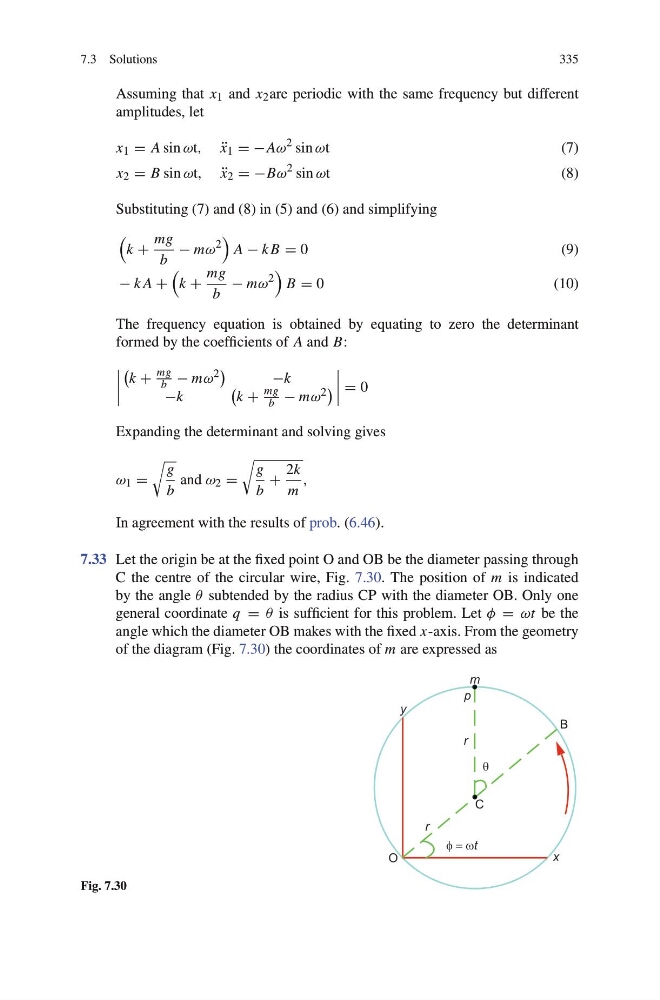
7.33 Let the origin be at the fixed point O and OB be the diameter passing through
C the centre of the circular wire, Fig. 7.30. The position of m is indicated
by the angle θ subtended by the radius CP with the diameter OB. Only one
general coordinate q = θ is sufficient for this problem. Let φ = ωt be the
angle which the diameter OB makes with the fixed x-axis. From the geometry
of the diagram (Fig. 7.30) the coordinates of m are expressed as
Fig. 7.30
335
Assuming that x 1 and x 2 are periodic with the same frequency but different
amplitudes, let
x 1 = A sin ωt, ¨
x 1 = −Aω
2 sin ωt
( 7 )
x 2 = B sin ωt, ¨
x 2 = −Bω
2 sin ωt
( 8 )
Substituting (7) and (8) in (5) and (6) and simplifying
k +
mg
b
− mω
2
A − k B = 0
( 9 )
− k A +
k +
mg
b
− mω
2
B = 0
(10)
The frequency equation is obtained by equating to zero the determinant
formed by the coefficients of A and B:
k +
mg
b − mω 2
−k
−k
k +
mg
b − mω 2
= 0
Expanding the determinant and solving gives
ω 1 =
g
b
and ω 2 =
g
b
+
2k
m
,
In agreement with the results of prob. (6.46).
7.33 Let the origin be at the fixed point O and OB be the diameter passing through
C the centre of the circular wire, Fig. 7.30. The position of m is indicated
by the angle θ subtended by the radius CP with the diameter OB. Only one
general coordinate q = θ is sufficient for this problem. Let φ = ωt be the
angle which the diameter OB makes with the fixed x-axis. From the geometry
of the diagram (Fig. 7.30) the coordinates of m are expressed as
Fig. 7.30