

336
7 Lagrangian and Hamiltonian Mechanics
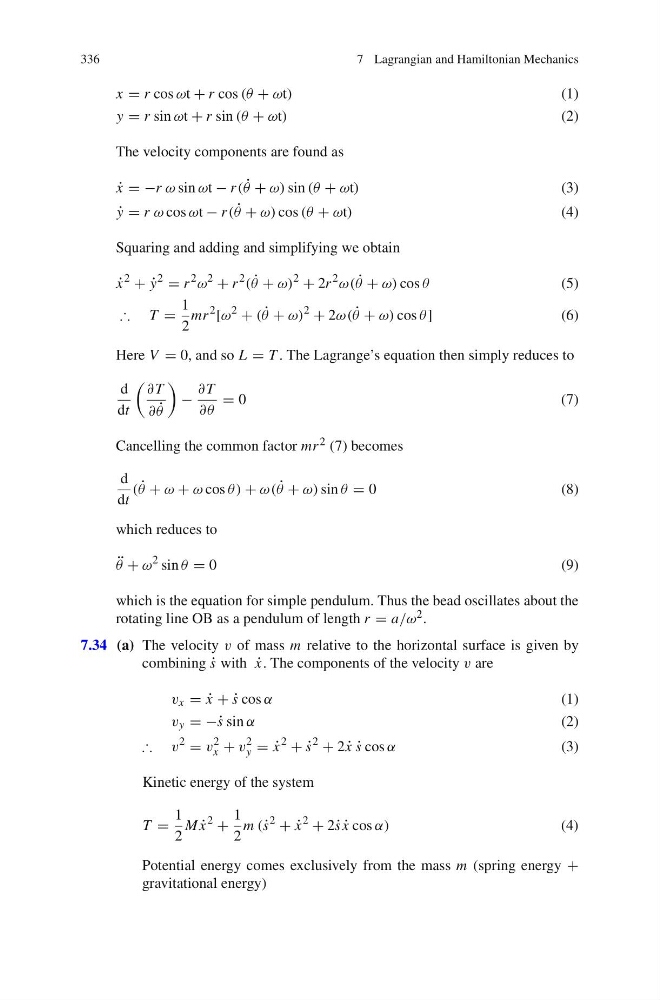
x = r cos ωt + r cos (θ + ωt)
(1)
y = r sin ωt + r sin (θ + ωt)
(2)
The velocity components are found as
˙
x = −r ω sin ωt − r ( ˙
θ + ω) sin (θ + ωt)
(3)
˙
y = r ω cos ωt − r ( ˙
θ + ω) cos (θ + ωt)
(4)
Squaring and adding and simplifying we obtain
˙
x
2
+ ˙
y
2
= r
2
ω
2
+ r
2
( ˙
θ + ω)
2
+ 2r
2
ω( ˙
θ + ω) cos θ
(5)
∴ T =
1
2
mr
2
[ω
2
+ ( ˙
θ + ω)
2
+ 2ω( ˙
θ + ω) cos θ ]
(6)
Here V = 0, and so L = T . The Lagrange’s equation then simply reduces to
d
dt
∂ T
∂ ˙
θ
−
∂ T
∂θ
= 0
( 7 )
Cancelling the common factor mr 2 (7) becomes
d
dt
( ˙
θ + ω + ω cos θ) + ω( ˙
θ + ω) sin θ = 0
( 8 )
which reduces to
¨
θ + ω
2 sin θ = 0
( 9 )
which is the equation for simple pendulum. Thus the bead oscillates about the
rotating line OB as a pendulum of length r = a/ω 2 .
7.34 (a) The velocity v of mass m relative to the horizontal surface is given by
combining ˙
s with ˙
x. The components of the velocity v are
v x = ˙
x + ˙
s cos α
(1)
v y = −˙ s sin α
(2)
∴ v
2
= v
2
x + v
2
y = ˙
x
2
+ ˙
s
2
+ 2 ˙
x ˙
s cos α
(3)
Kinetic energy of the system
T =
1
2
M ˙
x
2
+
1
2
m (˙ s
2
+ ˙
x
2
+ 2˙ s ˙
x cos α)
(4)
Potential energy comes exclusively from the mass m (spring energy +
gravitational energy)
7 Lagrangian and Hamiltonian Mechanics
x = r cos ωt + r cos (θ + ωt)
(1)
y = r sin ωt + r sin (θ + ωt)
(2)
The velocity components are found as
˙
x = −r ω sin ωt − r ( ˙
θ + ω) sin (θ + ωt)
(3)
˙
y = r ω cos ωt − r ( ˙
θ + ω) cos (θ + ωt)
(4)
Squaring and adding and simplifying we obtain
˙
x
2
+ ˙
y
2
= r
2
ω
2
+ r
2
( ˙
θ + ω)
2
+ 2r
2
ω( ˙
θ + ω) cos θ
(5)
∴ T =
1
2
mr
2
[ω
2
+ ( ˙
θ + ω)
2
+ 2ω( ˙
θ + ω) cos θ ]
(6)
Here V = 0, and so L = T . The Lagrange’s equation then simply reduces to
d
dt
∂ T
∂ ˙
θ
−
∂ T
∂θ
= 0
( 7 )
Cancelling the common factor mr 2 (7) becomes
d
dt
( ˙
θ + ω + ω cos θ) + ω( ˙
θ + ω) sin θ = 0
( 8 )
which reduces to
¨
θ + ω
2 sin θ = 0
( 9 )
which is the equation for simple pendulum. Thus the bead oscillates about the
rotating line OB as a pendulum of length r = a/ω 2 .
7.34 (a) The velocity v of mass m relative to the horizontal surface is given by
combining ˙
s with ˙
x. The components of the velocity v are
v x = ˙
x + ˙
s cos α
(1)
v y = −˙ s sin α
(2)
∴ v
2
= v
2
x + v
2
y = ˙
x
2
+ ˙
s
2
+ 2 ˙
x ˙
s cos α
(3)
Kinetic energy of the system
T =
1
2
M ˙
x
2
+
1
2
m (˙ s
2
+ ˙
x
2
+ 2˙ s ˙
x cos α)
(4)
Potential energy comes exclusively from the mass m (spring energy +
gravitational energy)