

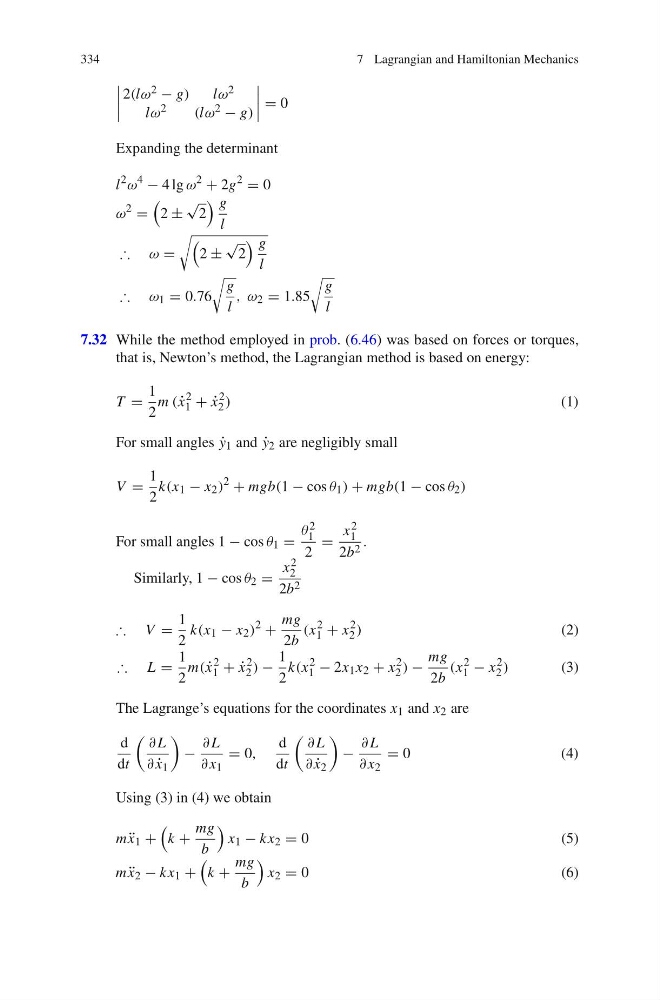
334
7 Lagrangian and Hamiltonian Mechanics
2(lω 2 − g)
lω 2
lω 2
(lω 2 − g)
= 0
Expanding the determinant
l
2
ω
4
− 4 lg ω
2
+ 2g
2
= 0
ω
2
=
2 ±
√
2
g
l
∴ ω =
2 ±
√
2
g
l
∴ ω 1 = 0.76
g
l
, ω 2 = 1.85
g
l
7.32 While the method employed in prob. (6.46) was based on forces or torques,
that is, Newton’s method, the Lagrangian method is based on energy:
T =
1
2
m ( ˙
x
2
1 + ˙
x
2
2 )
(1)
For small angles ˙
y 1 and ˙
y 2 are negligibly small
V =
1
2
k(x 1 − x 2 )
2
+ mgb(1 − cos θ 1 ) + mgb(1 − cos θ 2 )
For small angles 1 − cos θ 1 =
θ 2
1
2
=
x 2
1
2b 2 .
Similarly, 1 − cos θ 2 =
x 2
2
2b 2
∴ V =
1
2
k(x 1 − x 2 )
2
+
mg
2b
(x
2
1 + x
2
2 )
(2)
∴ L =
1
2
m( ˙
x
2
1 + ˙
x
2
2 ) −
1
2
k(x
2
1 − 2x 1 x 2 + x
2
2 ) −
mg
2b
(x
2
1 − x
2
2 )
(3)
The Lagrange’s equations for the coordinates x 1 and x 2 are
d
dt
∂ L
∂ ˙
x 1
−
∂ L
∂ x 1
= 0,
d
dt
∂ L
∂ ˙
x 2
−
∂ L
∂ x 2
= 0
( 4 )
Using (3) in (4) we obtain
m ¨
x 1 +
k +
mg
b
x 1 − kx 2 = 0
( 5 )
m ¨
x 2 − kx 1 +
k +
mg
b
x 2 = 0
( 6 )
7 Lagrangian and Hamiltonian Mechanics
2(lω 2 − g)
lω 2
lω 2
(lω 2 − g)
= 0
Expanding the determinant
l
2
ω
4
− 4 lg ω
2
+ 2g
2
= 0
ω
2
=
2 ±
√
2
g
l
∴ ω =
2 ±
√
2
g
l
∴ ω 1 = 0.76
g
l
, ω 2 = 1.85
g
l
7.32 While the method employed in prob. (6.46) was based on forces or torques,
that is, Newton’s method, the Lagrangian method is based on energy:
T =
1
2
m ( ˙
x
2
1 + ˙
x
2
2 )
(1)
For small angles ˙
y 1 and ˙
y 2 are negligibly small
V =
1
2
k(x 1 − x 2 )
2
+ mgb(1 − cos θ 1 ) + mgb(1 − cos θ 2 )
For small angles 1 − cos θ 1 =
θ 2
1
2
=
x 2
1
2b 2 .
Similarly, 1 − cos θ 2 =
x 2
2
2b 2
∴ V =
1
2
k(x 1 − x 2 )
2
+
mg
2b
(x
2
1 + x
2
2 )
(2)
∴ L =
1
2
m( ˙
x
2
1 + ˙
x
2
2 ) −
1
2
k(x
2
1 − 2x 1 x 2 + x
2
2 ) −
mg
2b
(x
2
1 − x
2
2 )
(3)
The Lagrange’s equations for the coordinates x 1 and x 2 are
d
dt
∂ L
∂ ˙
x 1
−
∂ L
∂ x 1
= 0,
d
dt
∂ L
∂ ˙
x 2
−
∂ L
∂ x 2
= 0
( 4 )
Using (3) in (4) we obtain
m ¨
x 1 +
k +
mg
b
x 1 − kx 2 = 0
( 5 )
m ¨
x 2 − kx 1 +
k +
mg
b
x 2 = 0
( 6 )