

326
7 Lagrangian and Hamiltonian Mechanics
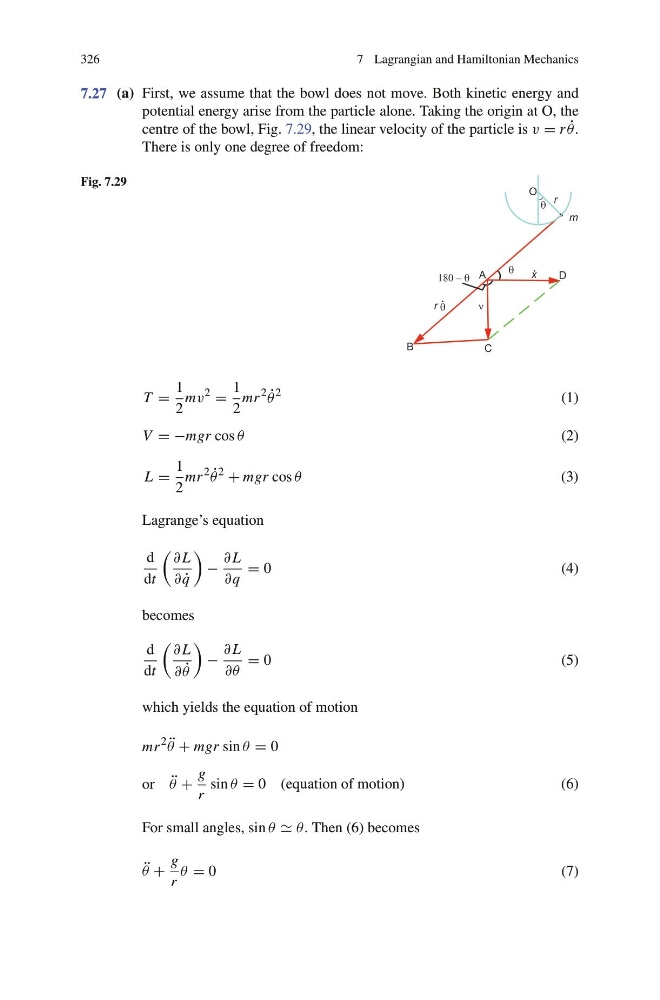
7.27 (a) First, we assume that the bowl does not move. Both kinetic energy and
potential energy arise from the particle alone. Taking the origin at O, the
centre of the bowl, Fig. 7.29, the linear velocity of the particle is v = r ˙
θ.
There is only one degree of freedom:
Fig. 7.29
T =
1
2
mv
2
=
1
2
mr
2 ˙
θ
2
(1)
V = −mgr cos θ
(2)
L =
1
2
mr
2 ˙
θ
2
+ mgr cos θ
(3)
Lagrange’s equation
d
dt
∂ L
∂ ˙
q
−
∂ L
∂q
= 0
( 4 )
becomes
d
dt
∂ L
∂ ˙
θ
−
∂ L
∂θ
= 0
( 5 )
which yields the equation of motion
mr
2 ¨
θ + mgr sin θ = 0
or ¨
θ +
g
r
sin θ = 0 (equation of motion)
(6)
For small angles, sin θ θ . Then (6) becomes
¨
θ +
g
r
θ = 0
( 7 )
7 Lagrangian and Hamiltonian Mechanics
7.27 (a) First, we assume that the bowl does not move. Both kinetic energy and
potential energy arise from the particle alone. Taking the origin at O, the
centre of the bowl, Fig. 7.29, the linear velocity of the particle is v = r ˙
θ.
There is only one degree of freedom:
Fig. 7.29
T =
1
2
mv
2
=
1
2
mr
2 ˙
θ
2
(1)
V = −mgr cos θ
(2)
L =
1
2
mr
2 ˙
θ
2
+ mgr cos θ
(3)
Lagrange’s equation
d
dt
∂ L
∂ ˙
q
−
∂ L
∂q
= 0
( 4 )
becomes
d
dt
∂ L
∂ ˙
θ
−
∂ L
∂θ
= 0
( 5 )
which yields the equation of motion
mr
2 ¨
θ + mgr sin θ = 0
or ¨
θ +
g
r
sin θ = 0 (equation of motion)
(6)
For small angles, sin θ θ . Then (6) becomes
¨
θ +
g
r
θ = 0
( 7 )