

7.3 Solutions
327
which is the equation for simple harmonic motion of frequency ω =
g
r
or time period
T =
2π
ω
= 2π
r
g
(8)
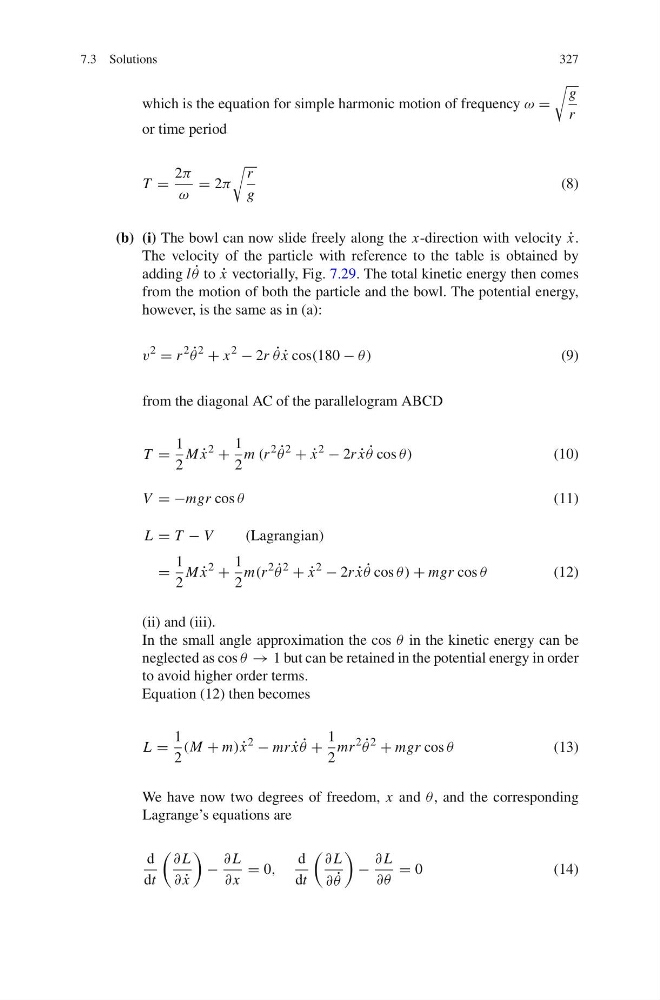
(b) (i) The bowl can now slide freely along the x-direction with velocity ˙
x.
The velocity of the particle with reference to the table is obtained by
adding l ˙
θ to ˙
x vectorially, Fig. 7.29. The total kinetic energy then comes
from the motion of both the particle and the bowl. The potential energy,
however, is the same as in (a):
v
2
= r
2 ˙
θ
2
+ x
2
− 2r ˙
θ ˙
x cos(180 − θ)
(9)
from the diagonal AC of the parallelogram ABCD
T =
1
2
M ˙
x
2
+
1
2
m (r
2 ˙
θ
2
+ ˙
x
2
− 2r ˙
x ˙
θ cos θ)
(10)
V = −mgr cos θ
(11)
L = T − V
(Lagrangian)
=
1
2
M ˙
x
2
+
1
2
m(r
2 ˙
θ
2
+ ˙
x
2
− 2r ˙
x ˙
θ cos θ) + mgr cos θ
(12)
(ii) and (iii).
In the small angle approximation the cos θ in the kinetic energy can be
neglected as cos θ → 1 but can be retained in the potential energy in order
to avoid higher order terms.
Equation (12) then becomes
L =
1
2
(M + m) ˙
x
2
− mr ˙
x ˙
θ +
1
2
mr
2 ˙
θ
2
+ mgr cos θ
(13)
We have now two degrees of freedom, x and θ , and the corresponding
Lagrange’s equations are
d
dt
∂ L
∂ ˙
x
−
∂ L
∂ x
= 0,
d
dt
∂ L
∂ ˙
θ
−
∂ L
∂θ
= 0
(14)
327
which is the equation for simple harmonic motion of frequency ω =
g
r
or time period
T =
2π
ω
= 2π
r
g
(8)
(b) (i) The bowl can now slide freely along the x-direction with velocity ˙
x.
The velocity of the particle with reference to the table is obtained by
adding l ˙
θ to ˙
x vectorially, Fig. 7.29. The total kinetic energy then comes
from the motion of both the particle and the bowl. The potential energy,
however, is the same as in (a):
v
2
= r
2 ˙
θ
2
+ x
2
− 2r ˙
θ ˙
x cos(180 − θ)
(9)
from the diagonal AC of the parallelogram ABCD
T =
1
2
M ˙
x
2
+
1
2
m (r
2 ˙
θ
2
+ ˙
x
2
− 2r ˙
x ˙
θ cos θ)
(10)
V = −mgr cos θ
(11)
L = T − V
(Lagrangian)
=
1
2
M ˙
x
2
+
1
2
m(r
2 ˙
θ
2
+ ˙
x
2
− 2r ˙
x ˙
θ cos θ) + mgr cos θ
(12)
(ii) and (iii).
In the small angle approximation the cos θ in the kinetic energy can be
neglected as cos θ → 1 but can be retained in the potential energy in order
to avoid higher order terms.
Equation (12) then becomes
L =
1
2
(M + m) ˙
x
2
− mr ˙
x ˙
θ +
1
2
mr
2 ˙
θ
2
+ mgr cos θ
(13)
We have now two degrees of freedom, x and θ , and the corresponding
Lagrange’s equations are
d
dt
∂ L
∂ ˙
x
−
∂ L
∂ x
= 0,
d
dt
∂ L
∂ ˙
θ
−
∂ L
∂θ
= 0
(14)