

7.3 Solutions
325
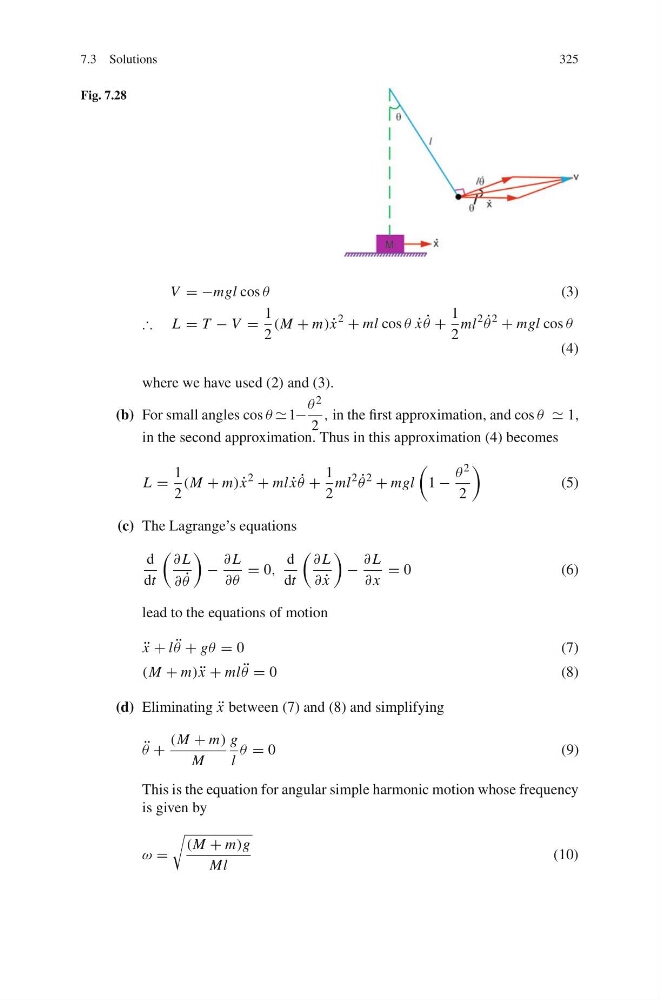
Fig. 7.28
V = −mgl cos θ
(3)
∴ L = T − V =
1
2
(M + m) ˙
x
2
+ ml cos θ ˙
x ˙
θ +
1
2
ml
2 ˙
θ
2
+ mgl cos θ
(4)
where we have used (2) and (3).
(b) For small angles cos θ 1−
θ 2
2
, in the first approximation, and cos θ 1,
in the second approximation. Thus in this approximation (4) becomes
L =
1
2
(M + m) ˙
x
2
+ ml ˙
x ˙
θ +
1
2
ml
2 ˙
θ
2
+ mgl
1 −
θ 2
2
(5)
(c) The Lagrange’s equations
d
dt
∂ L
∂ ˙
θ
−
∂ L
∂θ
= 0,
d
dt
∂ L
∂ ˙
x
−
∂ L
∂ x
= 0
( 6 )
lead to the equations of motion
¨
x + l ¨
θ + gθ = 0
( 7 )
(M + m) ¨
x + ml ¨
θ = 0
( 8 )
(d) Eliminating ¨
x between (7) and (8) and simplifying
¨
θ +
(M + m)
M
g
l
θ = 0
( 9 )
This is the equation for angular simple harmonic motion whose frequency
is given by
ω =
(M + m)g
Ml
(10)
325
Fig. 7.28
V = −mgl cos θ
(3)
∴ L = T − V =
1
2
(M + m) ˙
x
2
+ ml cos θ ˙
x ˙
θ +
1
2
ml
2 ˙
θ
2
+ mgl cos θ
(4)
where we have used (2) and (3).
(b) For small angles cos θ 1−
θ 2
2
, in the first approximation, and cos θ 1,
in the second approximation. Thus in this approximation (4) becomes
L =
1
2
(M + m) ˙
x
2
+ ml ˙
x ˙
θ +
1
2
ml
2 ˙
θ
2
+ mgl
1 −
θ 2
2
(5)
(c) The Lagrange’s equations
d
dt
∂ L
∂ ˙
θ
−
∂ L
∂θ
= 0,
d
dt
∂ L
∂ ˙
x
−
∂ L
∂ x
= 0
( 6 )
lead to the equations of motion
¨
x + l ¨
θ + gθ = 0
( 7 )
(M + m) ¨
x + ml ¨
θ = 0
( 8 )
(d) Eliminating ¨
x between (7) and (8) and simplifying
¨
θ +
(M + m)
M
g
l
θ = 0
( 9 )
This is the equation for angular simple harmonic motion whose frequency
is given by
ω =
(M + m)g
Ml
(10)