

324
7 Lagrangian and Hamiltonian Mechanics
only ω 3 is observed optically. The frequency ω 2 is not observed because in
this mode, the electrical centre of the system is always coincident with the
centre of mass, and so there is no oscillating dipole moment er available.
Hence dipole radiation is not emitted for this mode. On the other hand in the
third mode characterized by ω 3 such a moment is present and radiation is
emitted.
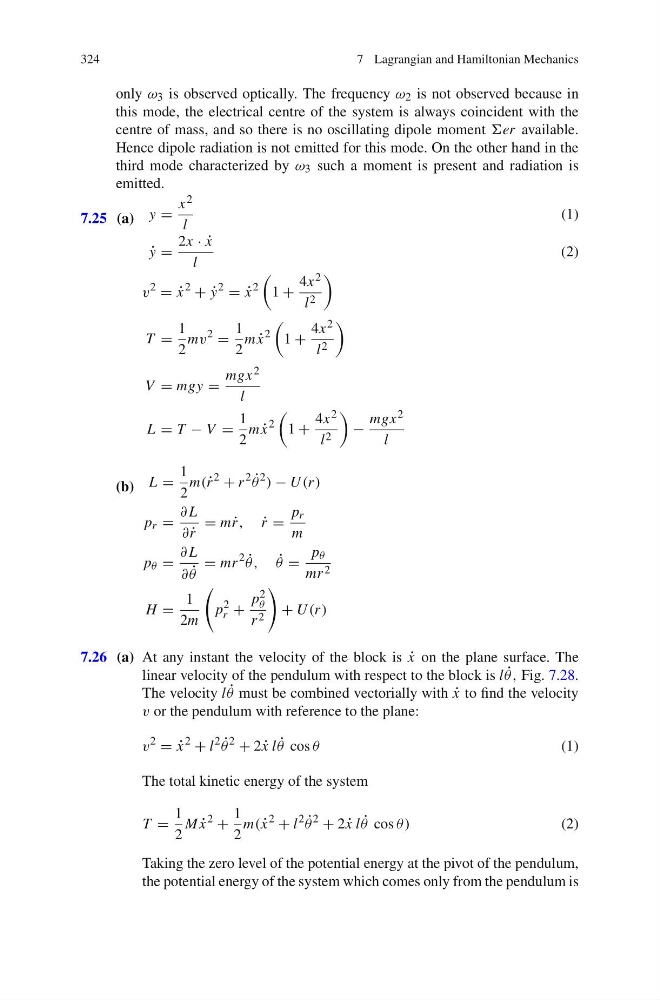
7.25 (a) y =
x 2
l
(1)
˙
y =
2x · ˙
x
l
(2)
v
2
= ˙
x
2
+ ˙
y
2
= ˙
x
2
1 +
4x 2
l 2
T =
1
2
mv
2
=
1
2
m ˙
x
2
1 +
4x 2
l 2
V = mgy =
mgx 2
l
L = T − V =
1
2
m ˙
x
2
1 +
4x 2
l 2
−
mgx 2
l
(b) L =
1
2
m(˙ r
2
+ r
2 ˙
θ
2
) − U (r )
p r =
∂ L
∂ ˙
r
= m ˙
r , ˙
r =
p r
m
p θ =
∂ L
∂ ˙
θ
= mr
2 ˙
θ, ˙
θ =
p θ
mr 2
H =
1
2m
p
2
r +
p 2
θ
r 2
+ U (r )
7.26 (a) At any instant the velocity of the block is ˙
x on the plane surface. The
linear velocity of the pendulum with respect to the block is l ˙
θ, Fig. 7.28.
The velocity l ˙
θ must be combined vectorially with ˙
x to find the velocity
v or the pendulum with reference to the plane:
v
2
= ˙
x
2
+ l
2 ˙
θ
2
+ 2 ˙
x l ˙
θ cos θ
(1)
The total kinetic energy of the system
T =
1
2
M ˙
x
2
+
1
2
m( ˙
x
2
+ l
2 ˙
θ
2
+ 2 ˙
x l ˙
θ cos θ)
(2)
Taking the zero level of the potential energy at the pivot of the pendulum,
the potential energy of the system which comes only from the pendulum is
7 Lagrangian and Hamiltonian Mechanics
only ω 3 is observed optically. The frequency ω 2 is not observed because in
this mode, the electrical centre of the system is always coincident with the
centre of mass, and so there is no oscillating dipole moment er available.
Hence dipole radiation is not emitted for this mode. On the other hand in the
third mode characterized by ω 3 such a moment is present and radiation is
emitted.
7.25 (a) y =
x 2
l
(1)
˙
y =
2x · ˙
x
l
(2)
v
2
= ˙
x
2
+ ˙
y
2
= ˙
x
2
1 +
4x 2
l 2
T =
1
2
mv
2
=
1
2
m ˙
x
2
1 +
4x 2
l 2
V = mgy =
mgx 2
l
L = T − V =
1
2
m ˙
x
2
1 +
4x 2
l 2
−
mgx 2
l
(b) L =
1
2
m(˙ r
2
+ r
2 ˙
θ
2
) − U (r )
p r =
∂ L
∂ ˙
r
= m ˙
r , ˙
r =
p r
m
p θ =
∂ L
∂ ˙
θ
= mr
2 ˙
θ, ˙
θ =
p θ
mr 2
H =
1
2m
p
2
r +
p 2
θ
r 2
+ U (r )
7.26 (a) At any instant the velocity of the block is ˙
x on the plane surface. The
linear velocity of the pendulum with respect to the block is l ˙
θ, Fig. 7.28.
The velocity l ˙
θ must be combined vectorially with ˙
x to find the velocity
v or the pendulum with reference to the plane:
v
2
= ˙
x
2
+ l
2 ˙
θ
2
+ 2 ˙
x l ˙
θ cos θ
(1)
The total kinetic energy of the system
T =
1
2
M ˙
x
2
+
1
2
m( ˙
x
2
+ l
2 ˙
θ
2
+ 2 ˙
x l ˙
θ cos θ)
(2)
Taking the zero level of the potential energy at the pivot of the pendulum,
the potential energy of the system which comes only from the pendulum is