

7.3 Solutions
323
The frequency equation is obtained by equating to zero the determinant
formed by the coefficients of A, B and C
(k − mω 2 )
−k
0
−k
(2k − Mω 2 )
−k
0
−k
(k − mω 2 )
= 0
Expanding the determinant we obtain
ω
2
(k − mω
2
) (ω
2 Mm − 2km − Mk) = 0
(13)
The frequencies are
ω 1 = 0, ω 2 =
k
m
, ω 3 =
k(2m + M)
Mm
(14)
The frequency ω 1 = 0 simply means a translation of all the three particles
without vibration. Ratios of amplitudes of the three particles can be found out
by substituting ω 2 and ω 3 in (10), (11) and (12). Thus when ω = ω 2
k
m
is
substituted in (10), we find the amplitude for the central atom B = 0. When
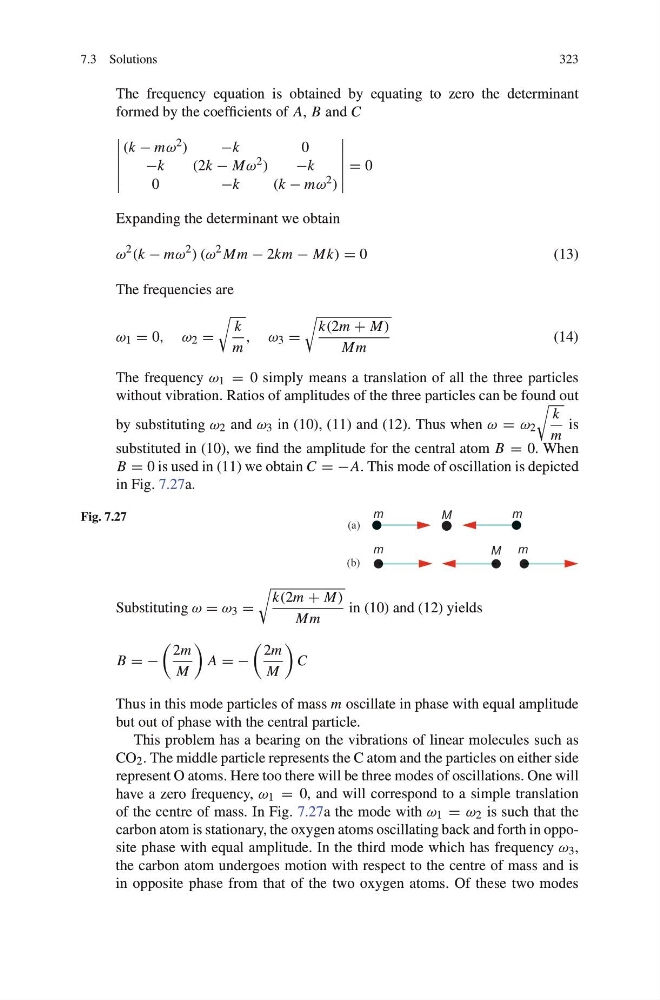
B = 0 is used in (11) we obtain C = −A. This mode of oscillation is depicted
in Fig. 7.27a.
Fig. 7.27
Substituting ω = ω 3 =
k(2m + M)
Mm
in (10) and (12) yields
B = −
2m
M
A = −
2m
M
C
Thus in this mode particles of mass m oscillate in phase with equal amplitude
but out of phase with the central particle.
This problem has a bearing on the vibrations of linear molecules such as
CO 2 . The middle particle represents the C atom and the particles on either side
represent O atoms. Here too there will be three modes of oscillations. One will
have a zero frequency, ω 1 = 0, and will correspond to a simple translation
of the centre of mass. In Fig. 7.27a the mode with ω 1 = ω 2 is such that the
carbon atom is stationary, the oxygen atoms oscillating back and forth in opposite phase with equal amplitude. In the third mode which has frequency ω 3 ,
the carbon atom undergoes motion with respect to the centre of mass and is
in opposite phase from that of the two oxygen atoms. Of these two modes
323
The frequency equation is obtained by equating to zero the determinant
formed by the coefficients of A, B and C
(k − mω 2 )
−k
0
−k
(2k − Mω 2 )
−k
0
−k
(k − mω 2 )
= 0
Expanding the determinant we obtain
ω
2
(k − mω
2
) (ω
2 Mm − 2km − Mk) = 0
(13)
The frequencies are
ω 1 = 0, ω 2 =
k
m
, ω 3 =
k(2m + M)
Mm
(14)
The frequency ω 1 = 0 simply means a translation of all the three particles
without vibration. Ratios of amplitudes of the three particles can be found out
by substituting ω 2 and ω 3 in (10), (11) and (12). Thus when ω = ω 2
k
m
is
substituted in (10), we find the amplitude for the central atom B = 0. When
B = 0 is used in (11) we obtain C = −A. This mode of oscillation is depicted
in Fig. 7.27a.
Fig. 7.27
Substituting ω = ω 3 =
k(2m + M)
Mm
in (10) and (12) yields
B = −
2m
M
A = −
2m
M
C
Thus in this mode particles of mass m oscillate in phase with equal amplitude
but out of phase with the central particle.
This problem has a bearing on the vibrations of linear molecules such as
CO 2 . The middle particle represents the C atom and the particles on either side
represent O atoms. Here too there will be three modes of oscillations. One will
have a zero frequency, ω 1 = 0, and will correspond to a simple translation
of the centre of mass. In Fig. 7.27a the mode with ω 1 = ω 2 is such that the
carbon atom is stationary, the oxygen atoms oscillating back and forth in opposite phase with equal amplitude. In the third mode which has frequency ω 3 ,
the carbon atom undergoes motion with respect to the centre of mass and is
in opposite phase from that of the two oxygen atoms. Of these two modes