

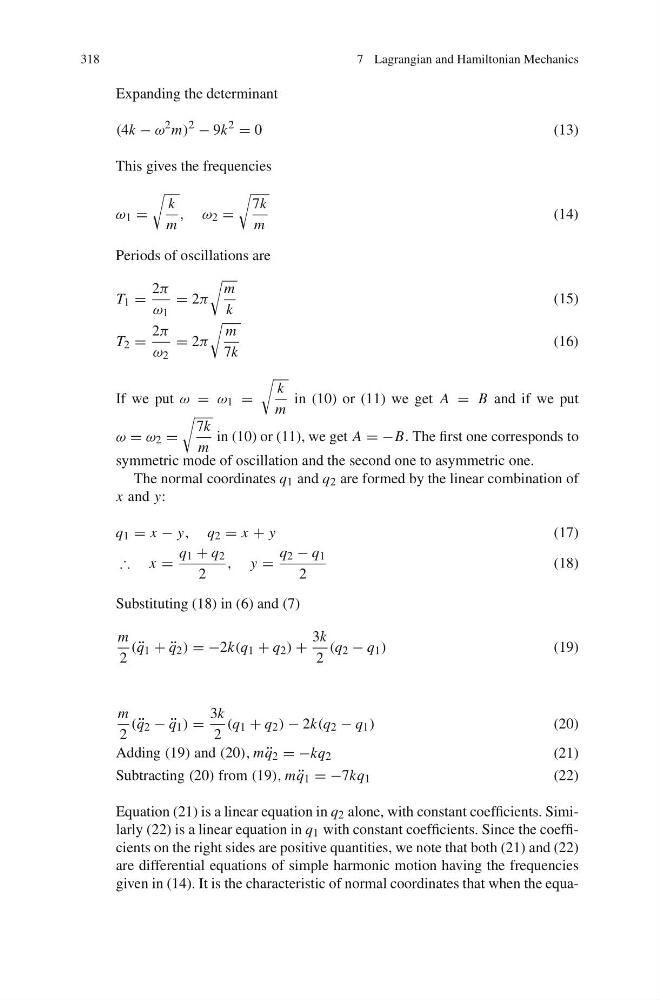
318
7 Lagrangian and Hamiltonian Mechanics
Expanding the determinant
(4k − ω
2 m)
2
− 9k
2
= 0
(13)
This gives the frequencies
ω 1 =
k
m
, ω 2 =
7k
m
(14)
Periods of oscillations are
T 1 =
2π
ω 1
= 2π
m
k
(15)
T 2 =
2π
ω 2
= 2π
m
7k
(16)
If we put ω = ω 1 =
k
m
in (10) or (11) we get A = B and if we put
ω = ω 2 =
7k
m
in (10) or (11), we get A = −B. The first one corresponds to
symmetric mode of oscillation and the second one to asymmetric one.
The normal coordinates q 1 and q 2 are formed by the linear combination of
x and y:
q 1 = x − y, q 2 = x + y
(17)
∴ x =
q 1 + q 2
2
, y =
q 2 − q 1
2
(18)
Substituting (18) in (6) and (7)
m
2
( ¨
q 1 + ¨
q 2 ) = −2k(q 1 + q 2 ) +
3k
2
(q 2 − q 1 )
(19)
m
2
( ¨
q 2 − ¨
q 1 ) =
3k
2
(q 1 + q 2 ) − 2k(q 2 − q 1 )
(20)
Adding (19) and (20), m ¨
q 2 = −kq 2
(21)
Subtracting (20) from (19), m ¨
q 1 = −7kq 1
(22)
Equation (21) is a linear equation in q 2 alone, with constant coefficients. Similarly (22) is a linear equation in q 1 with constant coefficients. Since the coefficients on the right sides are positive quantities, we note that both (21) and (22)
are differential equations of simple harmonic motion having the frequencies
given in (14). It is the characteristic of normal coordinates that when the equa-
7 Lagrangian and Hamiltonian Mechanics
Expanding the determinant
(4k − ω
2 m)
2
− 9k
2
= 0
(13)
This gives the frequencies
ω 1 =
k
m
, ω 2 =
7k
m
(14)
Periods of oscillations are
T 1 =
2π
ω 1
= 2π
m
k
(15)
T 2 =
2π
ω 2
= 2π
m
7k
(16)
If we put ω = ω 1 =
k
m
in (10) or (11) we get A = B and if we put
ω = ω 2 =
7k
m
in (10) or (11), we get A = −B. The first one corresponds to
symmetric mode of oscillation and the second one to asymmetric one.
The normal coordinates q 1 and q 2 are formed by the linear combination of
x and y:
q 1 = x − y, q 2 = x + y
(17)
∴ x =
q 1 + q 2
2
, y =
q 2 − q 1
2
(18)
Substituting (18) in (6) and (7)
m
2
( ¨
q 1 + ¨
q 2 ) = −2k(q 1 + q 2 ) +
3k
2
(q 2 − q 1 )
(19)
m
2
( ¨
q 2 − ¨
q 1 ) =
3k
2
(q 1 + q 2 ) − 2k(q 2 − q 1 )
(20)
Adding (19) and (20), m ¨
q 2 = −kq 2
(21)
Subtracting (20) from (19), m ¨
q 1 = −7kq 1
(22)
Equation (21) is a linear equation in q 2 alone, with constant coefficients. Similarly (22) is a linear equation in q 1 with constant coefficients. Since the coefficients on the right sides are positive quantities, we note that both (21) and (22)
are differential equations of simple harmonic motion having the frequencies
given in (14). It is the characteristic of normal coordinates that when the equa-