

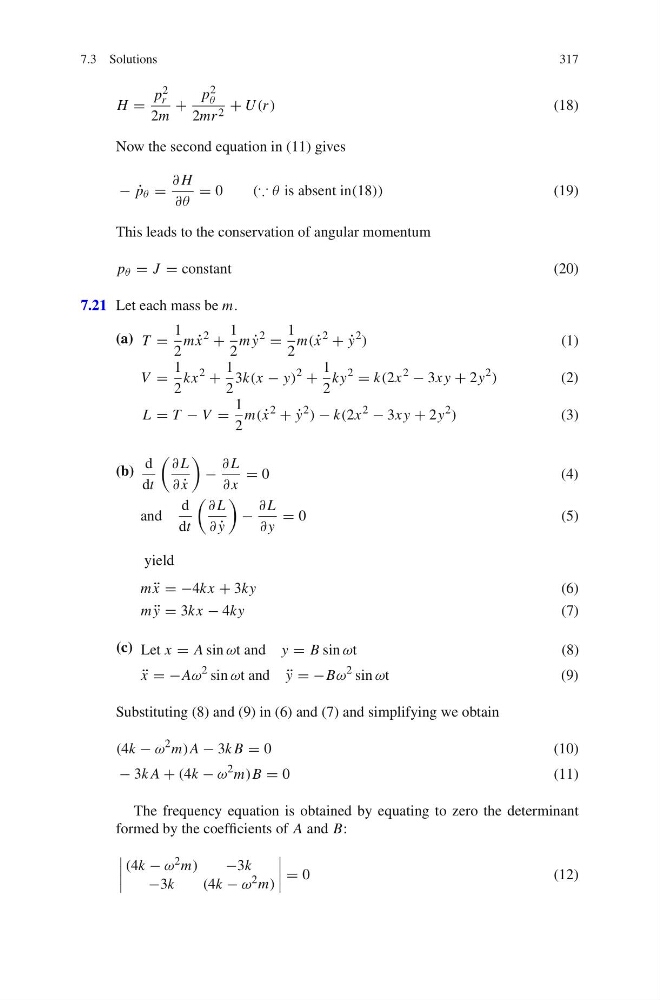
7.3 Solutions
317
H =
p 2
r
2m
+
p 2
θ
2mr 2 + U (r )
(18)
Now the second equation in (11) gives
− ˙
p θ =
∂ H
∂θ
= 0
(∵ θ is absent in(18))
(19)
This leads to the conservation of angular momentum
p θ = J = constant
(20)
7.21 Let each mass be m.
(a) T =
1
2
m ˙
x
2
+
1
2
m ˙
y
2
=
1
2
m( ˙
x
2
+ ˙
y
2
)
(1)
V =
1
2
kx
2
+
1
2
3k(x − y)
2
+
1
2
ky
2
= k(2x
2
− 3x y + 2y
2
)
(2)
L = T − V =
1
2
m( ˙
x
2
+ ˙
y
2
) − k(2x
2
− 3x y + 2y
2
)
(3)
(b)
d
dt
∂ L
∂ ˙
x
−
∂ L
∂ x
= 0
( 4 )
and
d
dt
∂ L
∂ ˙
y
−
∂ L
∂ y
= 0
( 5 )
yield
m ¨
x = −4kx + 3ky
(6)
m ¨
y = 3kx − 4ky
(7)
(c) Let x = A sin ωt and y = B sin ωt
( 8 )
¨
x = −Aω
2 sin ωt and ¨
y = −Bω
2 sin ωt
( 9 )
Substituting (8) and (9) in (6) and (7) and simplifying we obtain
(4k − ω
2 m)A − 3k B = 0
(10)
− 3k A + (4k − ω
2 m)B = 0
(11)
The frequency equation is obtained by equating to zero the determinant
formed by the coefficients of A and B:
(4k − ω 2 m)
−3k
−3k
(4k − ω 2 m)
= 0
(12)
317
H =
p 2
r
2m
+
p 2
θ
2mr 2 + U (r )
(18)
Now the second equation in (11) gives
− ˙
p θ =
∂ H
∂θ
= 0
(∵ θ is absent in(18))
(19)
This leads to the conservation of angular momentum
p θ = J = constant
(20)
7.21 Let each mass be m.
(a) T =
1
2
m ˙
x
2
+
1
2
m ˙
y
2
=
1
2
m( ˙
x
2
+ ˙
y
2
)
(1)
V =
1
2
kx
2
+
1
2
3k(x − y)
2
+
1
2
ky
2
= k(2x
2
− 3x y + 2y
2
)
(2)
L = T − V =
1
2
m( ˙
x
2
+ ˙
y
2
) − k(2x
2
− 3x y + 2y
2
)
(3)
(b)
d
dt
∂ L
∂ ˙
x
−
∂ L
∂ x
= 0
( 4 )
and
d
dt
∂ L
∂ ˙
y
−
∂ L
∂ y
= 0
( 5 )
yield
m ¨
x = −4kx + 3ky
(6)
m ¨
y = 3kx − 4ky
(7)
(c) Let x = A sin ωt and y = B sin ωt
( 8 )
¨
x = −Aω
2 sin ωt and ¨
y = −Bω
2 sin ωt
( 9 )
Substituting (8) and (9) in (6) and (7) and simplifying we obtain
(4k − ω
2 m)A − 3k B = 0
(10)
− 3k A + (4k − ω
2 m)B = 0
(11)
The frequency equation is obtained by equating to zero the determinant
formed by the coefficients of A and B:
(4k − ω 2 m)
−3k
−3k
(4k − ω 2 m)
= 0
(12)