

7.3 Solutions
319
tions of motion are expressed in terms of normal coordinates they are linear
with constant coefficients, and each contains but one dependent variable.
Another feature of normal coordinates is that both kinetic energy and
potential energy will have quadratic terms and the cross-products will be
absent. Thus in this example, when (18) is used in (1) and (2) we get the
expressions
T =
m
4
( ˙
q
2
1 + ˙
q
2
2 ), V =
k
4
(7q
2
1 + q
2
2 )
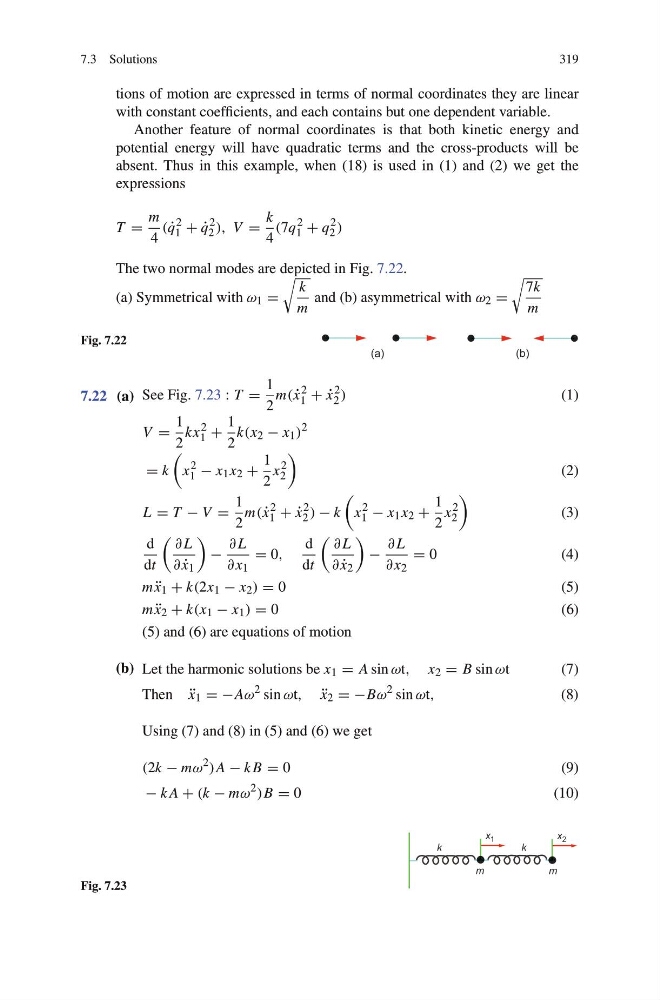
The two normal modes are depicted in Fig. 7.22.
(a) Symmetrical with ω 1 =
k
m
and (b) asymmetrical with ω 2 =
7k
m
Fig. 7.22
7.22 (a) See Fig. 7.23 : T =
1
2
m( ˙
x
2
1 + ˙
x
2
2 )
(1)
V =
1
2
kx
2
1 +
1
2
k(x 2 − x 1 )
2
= k
x
2
1 − x 1 x 2 +
1
2
x
2
2
(2)
L = T − V =
1
2
m( ˙
x
2
1 + ˙
x
2
2 ) − k
x
2
1 − x 1 x 2 +
1
2
x
2
2
(3)
d
dt
∂ L
∂ ˙
x 1
−
∂ L
∂ x 1
= 0,
d
dt
∂ L
∂ ˙
x 2
−
∂ L
∂ x 2
= 0
( 4 )
m ¨
x 1 + k(2x 1 − x 2 ) = 0
( 5 )
m ¨
x 2 + k(x 1 − x 1 ) = 0
( 6 )
(5) and (6) are equations of motion
(b) Let the harmonic solutions be x 1 = A sin ωt, x 2 = B sin ωt
( 7 )
Then ¨
x 1 = −Aω
2 sin ωt, ¨
x 2 = −Bω
2 sin ωt,
(8)
Using (7) and (8) in (5) and (6) we get
(2k − mω
2
)A − k B = 0
( 9 )
− k A + (k − mω
2
)B = 0
(10)
Fig. 7.23
319
tions of motion are expressed in terms of normal coordinates they are linear
with constant coefficients, and each contains but one dependent variable.
Another feature of normal coordinates is that both kinetic energy and
potential energy will have quadratic terms and the cross-products will be
absent. Thus in this example, when (18) is used in (1) and (2) we get the
expressions
T =
m
4
( ˙
q
2
1 + ˙
q
2
2 ), V =
k
4
(7q
2
1 + q
2
2 )
The two normal modes are depicted in Fig. 7.22.
(a) Symmetrical with ω 1 =
k
m
and (b) asymmetrical with ω 2 =
7k
m
Fig. 7.22
7.22 (a) See Fig. 7.23 : T =
1
2
m( ˙
x
2
1 + ˙
x
2
2 )
(1)
V =
1
2
kx
2
1 +
1
2
k(x 2 − x 1 )
2
= k
x
2
1 − x 1 x 2 +
1
2
x
2
2
(2)
L = T − V =
1
2
m( ˙
x
2
1 + ˙
x
2
2 ) − k
x
2
1 − x 1 x 2 +
1
2
x
2
2
(3)
d
dt
∂ L
∂ ˙
x 1
−
∂ L
∂ x 1
= 0,
d
dt
∂ L
∂ ˙
x 2
−
∂ L
∂ x 2
= 0
( 4 )
m ¨
x 1 + k(2x 1 − x 2 ) = 0
( 5 )
m ¨
x 2 + k(x 1 − x 1 ) = 0
( 6 )
(5) and (6) are equations of motion
(b) Let the harmonic solutions be x 1 = A sin ωt, x 2 = B sin ωt
( 7 )
Then ¨
x 1 = −Aω
2 sin ωt, ¨
x 2 = −Bω
2 sin ωt,
(8)
Using (7) and (8) in (5) and (6) we get
(2k − mω
2
)A − k B = 0
( 9 )
− k A + (k − mω
2
)B = 0
(10)
Fig. 7.23