

7.3 Solutions
297
We thus obtain
˙
x
2
+ ˙
y
2
= ˙
r
2
+ r
2 ˙
θ
2
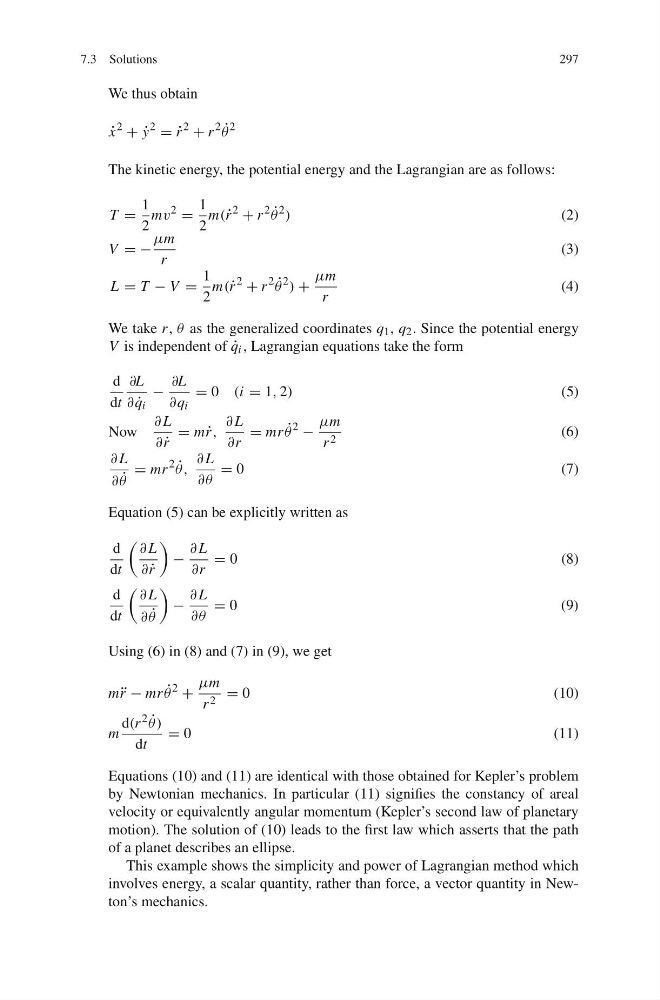
The kinetic energy, the potential energy and the Lagrangian are as follows:
T =
1
2
mv
2
=
1
2
m(˙ r
2
+ r
2 ˙
θ
2
)
(2)
V = −
μm
r
(3)
L = T − V =
1
2
m(˙ r
2
+ r
2 ˙
θ
2
) +
μm
r
(4)
We take r , θ as the generalized coordinates q 1 , q 2 . Since the potential energy
V is independent of ˙
q i , Lagrangian equations take the form
d
dt
∂L
∂ ˙
q i
−
∂L
∂q i
= 0 (i = 1, 2)
(5)
Now
∂ L
∂ ˙
r
= m ˙
r,
∂ L
∂r
= mr ˙
θ
2
−
μm
r 2
(6)
∂ L
∂ ˙
θ
= mr
2 ˙
θ,
∂ L
∂θ
= 0
( 7 )
Equation (5) can be explicitly written as
d
dt
∂ L
∂ ˙
r
−
∂ L
∂r
= 0
( 8 )
d
dt
∂ L
∂ ˙
θ
−
∂ L
∂θ
= 0
( 9 )
Using (6) in (8) and (7) in (9), we get
m ¨
r − mr ˙
θ
2
+
μm
r 2 = 0
(10)
m
d(r 2 ˙
θ)
dt
= 0
(11)
Equations (10) and (11) are identical with those obtained for Kepler’s problem
by Newtonian mechanics. In particular (11) signifies the constancy of areal
velocity or equivalently angular momentum (Kepler’s second law of planetary
motion). The solution of (10) leads to the first law which asserts that the path
of a planet describes an ellipse.
This example shows the simplicity and power of Lagrangian method which
involves energy, a scalar quantity, rather than force, a vector quantity in Newton’s mechanics.
297
We thus obtain
˙
x
2
+ ˙
y
2
= ˙
r
2
+ r
2 ˙
θ
2
The kinetic energy, the potential energy and the Lagrangian are as follows:
T =
1
2
mv
2
=
1
2
m(˙ r
2
+ r
2 ˙
θ
2
)
(2)
V = −
μm
r
(3)
L = T − V =
1
2
m(˙ r
2
+ r
2 ˙
θ
2
) +
μm
r
(4)
We take r , θ as the generalized coordinates q 1 , q 2 . Since the potential energy
V is independent of ˙
q i , Lagrangian equations take the form
d
dt
∂L
∂ ˙
q i
−
∂L
∂q i
= 0 (i = 1, 2)
(5)
Now
∂ L
∂ ˙
r
= m ˙
r,
∂ L
∂r
= mr ˙
θ
2
−
μm
r 2
(6)
∂ L
∂ ˙
θ
= mr
2 ˙
θ,
∂ L
∂θ
= 0
( 7 )
Equation (5) can be explicitly written as
d
dt
∂ L
∂ ˙
r
−
∂ L
∂r
= 0
( 8 )
d
dt
∂ L
∂ ˙
θ
−
∂ L
∂θ
= 0
( 9 )
Using (6) in (8) and (7) in (9), we get
m ¨
r − mr ˙
θ
2
+
μm
r 2 = 0
(10)
m
d(r 2 ˙
θ)
dt
= 0
(11)
Equations (10) and (11) are identical with those obtained for Kepler’s problem
by Newtonian mechanics. In particular (11) signifies the constancy of areal
velocity or equivalently angular momentum (Kepler’s second law of planetary
motion). The solution of (10) leads to the first law which asserts that the path
of a planet describes an ellipse.
This example shows the simplicity and power of Lagrangian method which
involves energy, a scalar quantity, rather than force, a vector quantity in Newton’s mechanics.