

296
7 Lagrangian and Hamiltonian Mechanics
where l is the natural length of the spring, x is the coordinate of the wedge
and s is the length of the spring.
(b) By using the Lagrangian derived in (a), show that the equations of motion
are as follows:
(m + M) ¨
x + m ¨
s cos α = 0,
m ¨
x cos α + m ¨
s + k(s − s 0 ) = 0,
where s 0 = l + (mg sin α)/k.
(c) By using the equations of motion in (b), derive the frequency for a small
amplitude oscillation of this system.
[University of Manchester 2008]
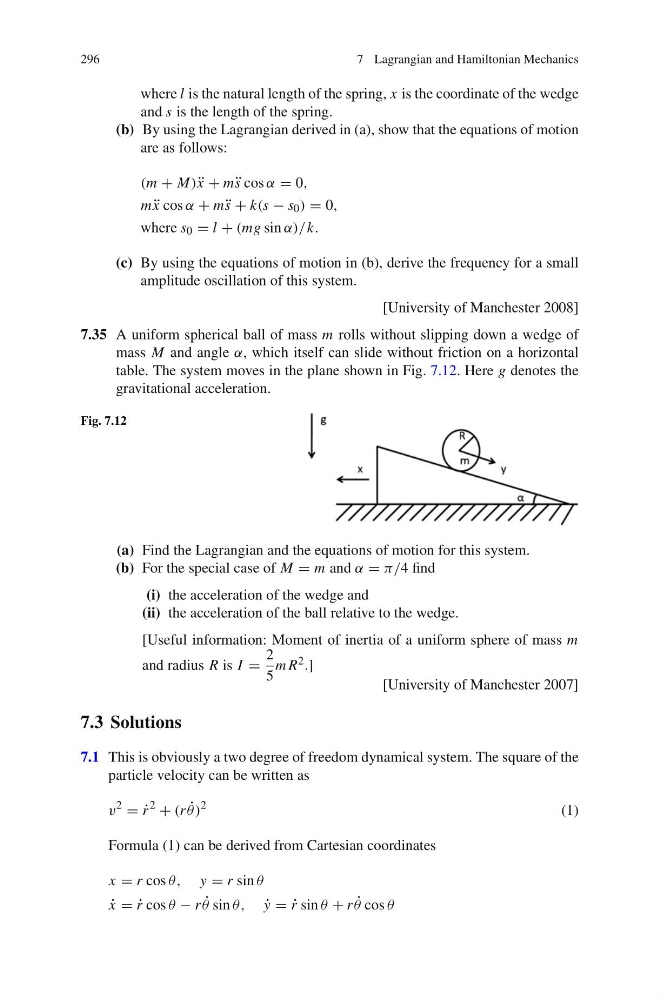
7.35 A uniform spherical ball of mass m rolls without slipping down a wedge of
mass M and angle α, which itself can slide without friction on a horizontal
table. The system moves in the plane shown in Fig. 7.12. Here g denotes the
gravitational acceleration.
Fig. 7.12
(a) Find the Lagrangian and the equations of motion for this system.
(b) For the special case of M = m and α = π/4 find
(i) the acceleration of the wedge and
(ii) the acceleration of the ball relative to the wedge.
[Useful information: Moment of inertia of a uniform sphere of mass m
and radius R is I =
2
5
m R 2 .]
[University of Manchester 2007]
7.3 Solutions
7.1 This is obviously a two degree of freedom dynamical system. The square of the
particle velocity can be written as
v
2
= ˙
r
2
+ (r ˙
θ)
2
(1)
Formula (1) can be derived from Cartesian coordinates
x = r cos θ, y = r sin θ
˙
x = ˙
r cos θ − r ˙
θ sin θ, ˙
y = ˙
r sin θ + r ˙
θ cos θ
7 Lagrangian and Hamiltonian Mechanics
where l is the natural length of the spring, x is the coordinate of the wedge
and s is the length of the spring.
(b) By using the Lagrangian derived in (a), show that the equations of motion
are as follows:
(m + M) ¨
x + m ¨
s cos α = 0,
m ¨
x cos α + m ¨
s + k(s − s 0 ) = 0,
where s 0 = l + (mg sin α)/k.
(c) By using the equations of motion in (b), derive the frequency for a small
amplitude oscillation of this system.
[University of Manchester 2008]
7.35 A uniform spherical ball of mass m rolls without slipping down a wedge of
mass M and angle α, which itself can slide without friction on a horizontal
table. The system moves in the plane shown in Fig. 7.12. Here g denotes the
gravitational acceleration.
Fig. 7.12
(a) Find the Lagrangian and the equations of motion for this system.
(b) For the special case of M = m and α = π/4 find
(i) the acceleration of the wedge and
(ii) the acceleration of the ball relative to the wedge.
[Useful information: Moment of inertia of a uniform sphere of mass m
and radius R is I =
2
5
m R 2 .]
[University of Manchester 2007]
7.3 Solutions
7.1 This is obviously a two degree of freedom dynamical system. The square of the
particle velocity can be written as
v
2
= ˙
r
2
+ (r ˙
θ)
2
(1)
Formula (1) can be derived from Cartesian coordinates
x = r cos θ, y = r sin θ
˙
x = ˙
r cos θ − r ˙
θ sin θ, ˙
y = ˙
r sin θ + r ˙
θ cos θ