

7.2 Problems
295
(i) Using θ as a coordinate, find the kinetic and potential energies of the
particle when moving on the ellipse. Write down the Lagrangian and
show that Lagrange’s equation becomes m(a 2 sin
2
θ + b 2 cos 2 θ) ¨
θ =
(a 2 − b 2 )(k − m ˙
θ 2 ) sin θ cos θ − mgb cos θ .
(ii) Show that θ = ±π/2 are two equilibrium points and find any other equilibrium points, giving carefully the conditions under which they exist.
You may either use Lagrange’s equation or proceed directly from the
potential energy.
(iii) Determine the stabilities of each of the two equilibrium points θ = ±π/2
(it may help to consider the cases a > b and a < b separately).
(iv) When the equilibrium point at θ = −π/2 is stable, determine the period
of small oscillations.
[University of Manchester 2008]
7.31 In prob. (7.12) on double pendulum if m 1 = m 2 = m and l 1 = l 2 = l, obtain
the frequencies of oscillation.
7.32 Use Lagrange’s equations to obtain the natural frequencies of oscillation of a
coupled pendulum described in prob. (6.46).
7.33 A bead of mass m slides freely on a smooth circular wire of radius r which
rotates with constant angular velocity ω. On a horizontal plane about a point
fixed on its circumference, show that the bead performs simple harmonic
motion about the diameter passing through the fixed point as a pendulum of
length r = g/ω 2 .
[with permission from Robert A. Becker, Introduction to theoretical
mechanics, McGraw-Hill Book Co., Inc., 1954]
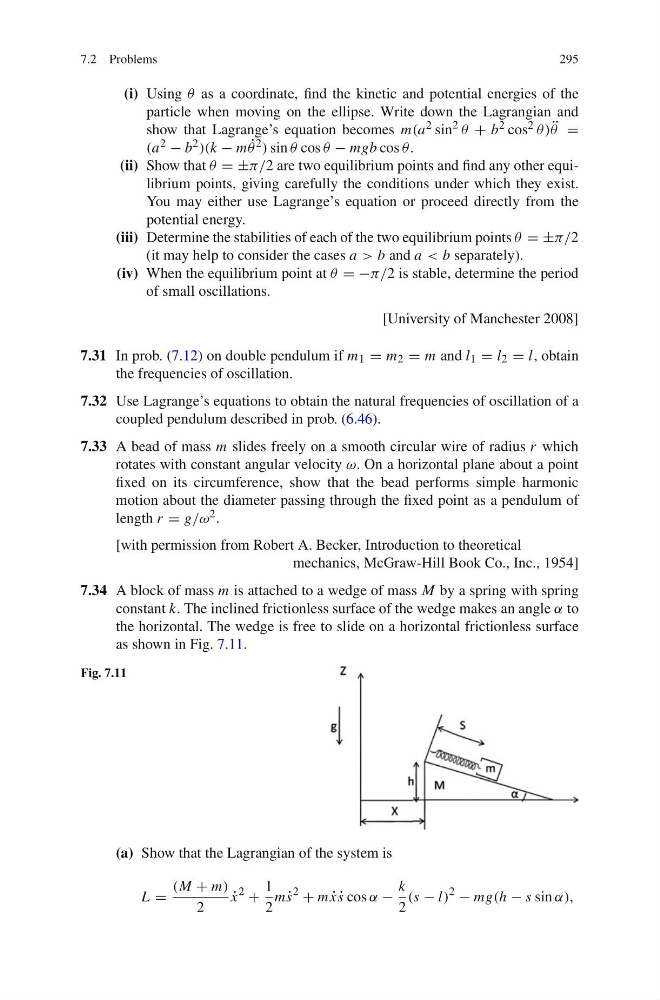
7.34 A block of mass m is attached to a wedge of mass M by a spring with spring
constant k. The inclined frictionless surface of the wedge makes an angle α to
the horizontal. The wedge is free to slide on a horizontal frictionless surface
as shown in Fig. 7.11.
Fig. 7.11
(a) Show that the Lagrangian of the system is
L =
(M + m)
2
˙
x
2
+
1
2
m ˙
s
2
+ m ˙
x ˙
s cos α −
k
2
(s − l)
2
− mg(h − s sin α),
295
(i) Using θ as a coordinate, find the kinetic and potential energies of the
particle when moving on the ellipse. Write down the Lagrangian and
show that Lagrange’s equation becomes m(a 2 sin
2
θ + b 2 cos 2 θ) ¨
θ =
(a 2 − b 2 )(k − m ˙
θ 2 ) sin θ cos θ − mgb cos θ .
(ii) Show that θ = ±π/2 are two equilibrium points and find any other equilibrium points, giving carefully the conditions under which they exist.
You may either use Lagrange’s equation or proceed directly from the
potential energy.
(iii) Determine the stabilities of each of the two equilibrium points θ = ±π/2
(it may help to consider the cases a > b and a < b separately).
(iv) When the equilibrium point at θ = −π/2 is stable, determine the period
of small oscillations.
[University of Manchester 2008]
7.31 In prob. (7.12) on double pendulum if m 1 = m 2 = m and l 1 = l 2 = l, obtain
the frequencies of oscillation.
7.32 Use Lagrange’s equations to obtain the natural frequencies of oscillation of a
coupled pendulum described in prob. (6.46).
7.33 A bead of mass m slides freely on a smooth circular wire of radius r which
rotates with constant angular velocity ω. On a horizontal plane about a point
fixed on its circumference, show that the bead performs simple harmonic
motion about the diameter passing through the fixed point as a pendulum of
length r = g/ω 2 .
[with permission from Robert A. Becker, Introduction to theoretical
mechanics, McGraw-Hill Book Co., Inc., 1954]
7.34 A block of mass m is attached to a wedge of mass M by a spring with spring
constant k. The inclined frictionless surface of the wedge makes an angle α to
the horizontal. The wedge is free to slide on a horizontal frictionless surface
as shown in Fig. 7.11.
Fig. 7.11
(a) Show that the Lagrangian of the system is
L =
(M + m)
2
˙
x
2
+
1
2
m ˙
s
2
+ m ˙
x ˙
s cos α −
k
2
(s − l)
2
− mg(h − s sin α),