

294
7 Lagrangian and Hamiltonian Mechanics
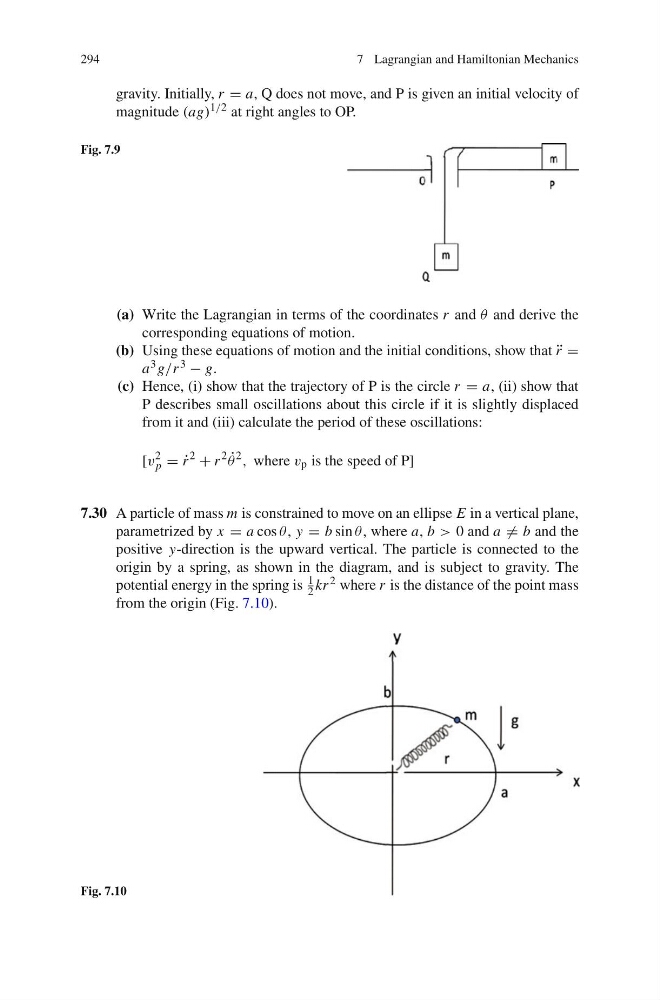
gravity. Initially, r = a, Q does not move, and P is given an initial velocity of
magnitude (ag) 1/2 at right angles to OP.
Fig. 7.9
(a) Write the Lagrangian in terms of the coordinates r and θ and derive the
corresponding equations of motion.
(b) Using these equations of motion and the initial conditions, show that ¨
r =
a 3 g/r 3 − g.
(c) Hence, (i) show that the trajectory of P is the circle r = a, (ii) show that
P describes small oscillations about this circle if it is slightly displaced
from it and (iii) calculate the period of these oscillations:
[v
2
p = ˙
r
2
+ r
2 ˙
θ
2
, where v p is the speed of P]
7.30 A particle of mass m is constrained to move on an ellipse E in a vertical plane,
parametrized by x = a cos θ , y = b sin θ , where a, b > 0 and a = b and the
positive y-direction is the upward vertical. The particle is connected to the
origin by a spring, as shown in the diagram, and is subject to gravity. The
potential energy in the spring is
1
2 kr 2 where r is the distance of the point mass
from the origin (Fig. 7.10).
Fig. 7.10
7 Lagrangian and Hamiltonian Mechanics
gravity. Initially, r = a, Q does not move, and P is given an initial velocity of
magnitude (ag) 1/2 at right angles to OP.
Fig. 7.9
(a) Write the Lagrangian in terms of the coordinates r and θ and derive the
corresponding equations of motion.
(b) Using these equations of motion and the initial conditions, show that ¨
r =
a 3 g/r 3 − g.
(c) Hence, (i) show that the trajectory of P is the circle r = a, (ii) show that
P describes small oscillations about this circle if it is slightly displaced
from it and (iii) calculate the period of these oscillations:
[v
2
p = ˙
r
2
+ r
2 ˙
θ
2
, where v p is the speed of P]
7.30 A particle of mass m is constrained to move on an ellipse E in a vertical plane,
parametrized by x = a cos θ , y = b sin θ , where a, b > 0 and a = b and the
positive y-direction is the upward vertical. The particle is connected to the
origin by a spring, as shown in the diagram, and is subject to gravity. The
potential energy in the spring is
1
2 kr 2 where r is the distance of the point mass
from the origin (Fig. 7.10).
Fig. 7.10