

7.2 Problems
293
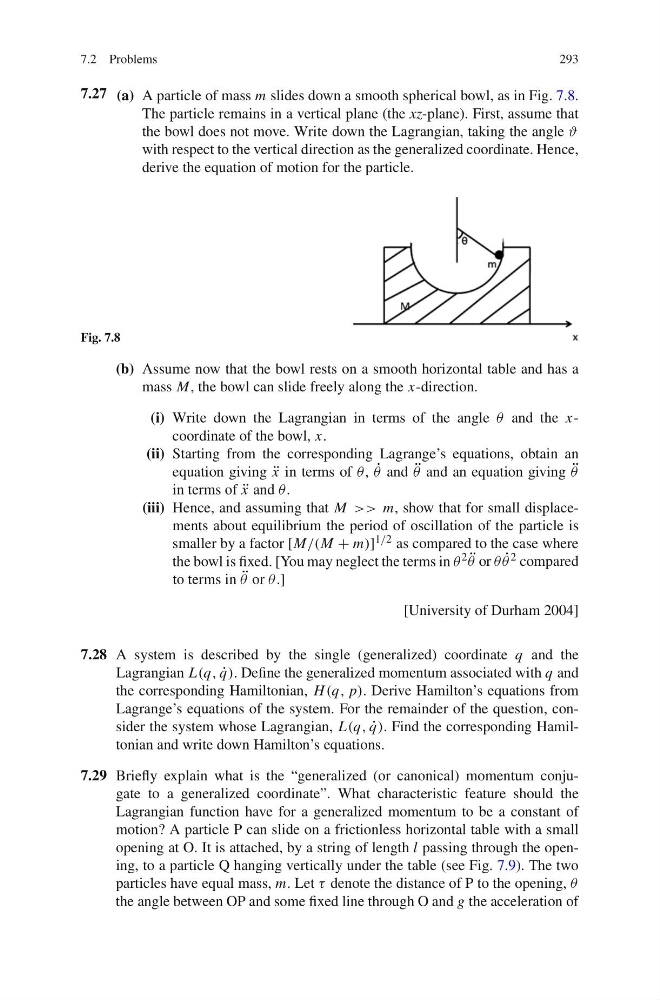
7.27 (a) A particle of mass m slides down a smooth spherical bowl, as in Fig. 7.8.
The particle remains in a vertical plane (the xz-plane). First, assume that
the bowl does not move. Write down the Lagrangian, taking the angle ϑ
with respect to the vertical direction as the generalized coordinate. Hence,
derive the equation of motion for the particle.
Fig. 7.8
(b) Assume now that the bowl rests on a smooth horizontal table and has a
mass M, the bowl can slide freely along the x-direction.
(i) Write down the Lagrangian in terms of the angle θ and the xcoordinate of the bowl, x.
(ii) Starting from the corresponding Lagrange’s equations, obtain an
equation giving ¨
x in terms of θ , ˙
θ and ¨
θ and an equation giving ¨
θ
in terms of ¨
x and θ .
(iii) Hence, and assuming that M >> m, show that for small displacements about equilibrium the period of oscillation of the particle is
smaller by a factor [M/(M + m)] 1/2 as compared to the case where
the bowl is fixed. [You may neglect the terms in θ 2 ¨
θ or θ ˙
θ 2 compared
to terms in ¨
θ or θ .]
[University of Durham 2004]
7.28 A system is described by the single (generalized) coordinate q and the
Lagrangian L(q, ˙
q). Define the generalized momentum associated with q and
the corresponding Hamiltonian, H (q, p). Derive Hamilton’s equations from
Lagrange’s equations of the system. For the remainder of the question, consider the system whose Lagrangian, L(q, ˙
q). Find the corresponding Hamiltonian and write down Hamilton’s equations.
7.29 Briefly explain what is the “generalized (or canonical) momentum conjugate to a generalized coordinate”. What characteristic feature should the
Lagrangian function have for a generalized momentum to be a constant of
motion? A particle P can slide on a frictionless horizontal table with a small
opening at O. It is attached, by a string of length l passing through the opening, to a particle Q hanging vertically under the table (see Fig. 7.9). The two
particles have equal mass, m. Let τ denote the distance of P to the opening, θ
the angle between OP and some fixed line through O and g the acceleration of
293
7.27 (a) A particle of mass m slides down a smooth spherical bowl, as in Fig. 7.8.
The particle remains in a vertical plane (the xz-plane). First, assume that
the bowl does not move. Write down the Lagrangian, taking the angle ϑ
with respect to the vertical direction as the generalized coordinate. Hence,
derive the equation of motion for the particle.
Fig. 7.8
(b) Assume now that the bowl rests on a smooth horizontal table and has a
mass M, the bowl can slide freely along the x-direction.
(i) Write down the Lagrangian in terms of the angle θ and the xcoordinate of the bowl, x.
(ii) Starting from the corresponding Lagrange’s equations, obtain an
equation giving ¨
x in terms of θ , ˙
θ and ¨
θ and an equation giving ¨
θ
in terms of ¨
x and θ .
(iii) Hence, and assuming that M >> m, show that for small displacements about equilibrium the period of oscillation of the particle is
smaller by a factor [M/(M + m)] 1/2 as compared to the case where
the bowl is fixed. [You may neglect the terms in θ 2 ¨
θ or θ ˙
θ 2 compared
to terms in ¨
θ or θ .]
[University of Durham 2004]
7.28 A system is described by the single (generalized) coordinate q and the
Lagrangian L(q, ˙
q). Define the generalized momentum associated with q and
the corresponding Hamiltonian, H (q, p). Derive Hamilton’s equations from
Lagrange’s equations of the system. For the remainder of the question, consider the system whose Lagrangian, L(q, ˙
q). Find the corresponding Hamiltonian and write down Hamilton’s equations.
7.29 Briefly explain what is the “generalized (or canonical) momentum conjugate to a generalized coordinate”. What characteristic feature should the
Lagrangian function have for a generalized momentum to be a constant of
motion? A particle P can slide on a frictionless horizontal table with a small
opening at O. It is attached, by a string of length l passing through the opening, to a particle Q hanging vertically under the table (see Fig. 7.9). The two
particles have equal mass, m. Let τ denote the distance of P to the opening, θ
the angle between OP and some fixed line through O and g the acceleration of