

292
7 Lagrangian and Hamiltonian Mechanics
7.24 Three identical particles of mass m, M and m with M in the middle are connected by two identical massless springs with a spring constant k. Find the
normal modes of oscillation and the associated frequencies.
7.25 (a) A bead of mass m is constrained to move under gravity along a planar
rigid wire that has a parabolic shape y = x 2 /l, where x and y are,
respectively, the horizontal and the vertical coordinates. Show that the
Lagrangian for the system is
L =
m( ˙
x) 2
2
1 +
4x 2
l 2
−
mgx 2
l
(b) Derive the Hamiltonian for a single particle of mass m moving in one
dimension subject to a conservative force with a potential U (x).
[University of Manchester 2006]
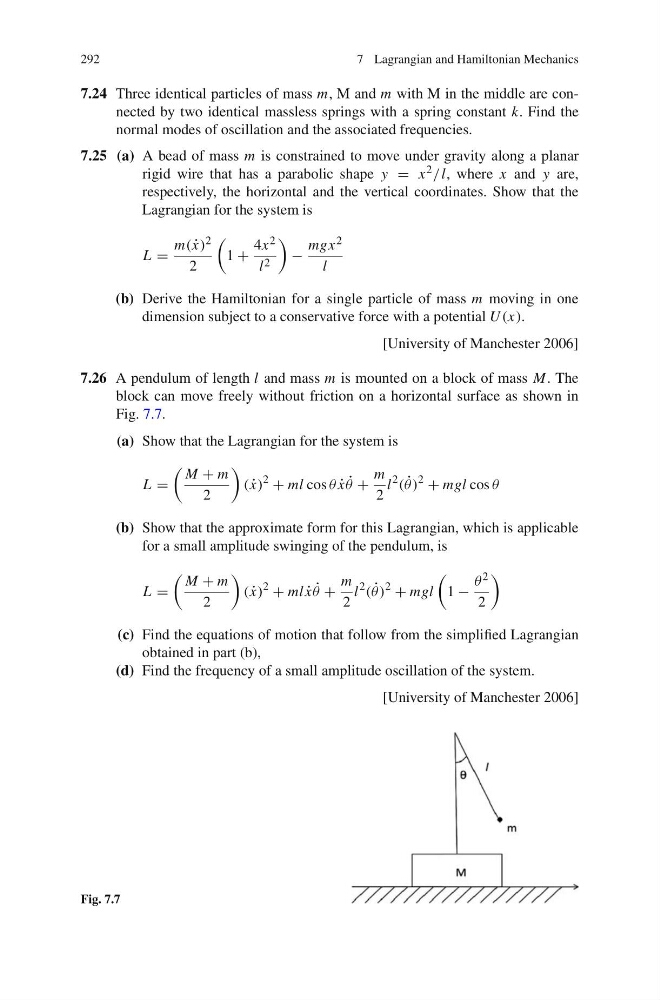
7.26 A pendulum of length l and mass m is mounted on a block of mass M. The
block can move freely without friction on a horizontal surface as shown in
Fig. 7.7.
(a) Show that the Lagrangian for the system is
L =
M + m
2
( ˙
x)
2
+ ml cos θ ˙
x ˙
θ +
m
2
l
2
( ˙
θ)
2
+ mgl cos θ
(b) Show that the approximate form for this Lagrangian, which is applicable
for a small amplitude swinging of the pendulum, is
L =
M + m
2
( ˙
x)
2
+ ml ˙
x ˙
θ +
m
2
l
2
( ˙
θ)
2
+ mgl
1 −
θ 2
2
(c) Find the equations of motion that follow from the simplified Lagrangian
obtained in part (b),
(d) Find the frequency of a small amplitude oscillation of the system.
[University of Manchester 2006]
Fig. 7.7
7 Lagrangian and Hamiltonian Mechanics
7.24 Three identical particles of mass m, M and m with M in the middle are connected by two identical massless springs with a spring constant k. Find the
normal modes of oscillation and the associated frequencies.
7.25 (a) A bead of mass m is constrained to move under gravity along a planar
rigid wire that has a parabolic shape y = x 2 /l, where x and y are,
respectively, the horizontal and the vertical coordinates. Show that the
Lagrangian for the system is
L =
m( ˙
x) 2
2
1 +
4x 2
l 2
−
mgx 2
l
(b) Derive the Hamiltonian for a single particle of mass m moving in one
dimension subject to a conservative force with a potential U (x).
[University of Manchester 2006]
7.26 A pendulum of length l and mass m is mounted on a block of mass M. The
block can move freely without friction on a horizontal surface as shown in
Fig. 7.7.
(a) Show that the Lagrangian for the system is
L =
M + m
2
( ˙
x)
2
+ ml cos θ ˙
x ˙
θ +
m
2
l
2
( ˙
θ)
2
+ mgl cos θ
(b) Show that the approximate form for this Lagrangian, which is applicable
for a small amplitude swinging of the pendulum, is
L =
M + m
2
( ˙
x)
2
+ ml ˙
x ˙
θ +
m
2
l
2
( ˙
θ)
2
+ mgl
1 −
θ 2
2
(c) Find the equations of motion that follow from the simplified Lagrangian
obtained in part (b),
(d) Find the frequency of a small amplitude oscillation of the system.
[University of Manchester 2006]
Fig. 7.7