

7.2 Problems
291
(c) Find the normal modes of oscillation of this system and their period of
oscillation.
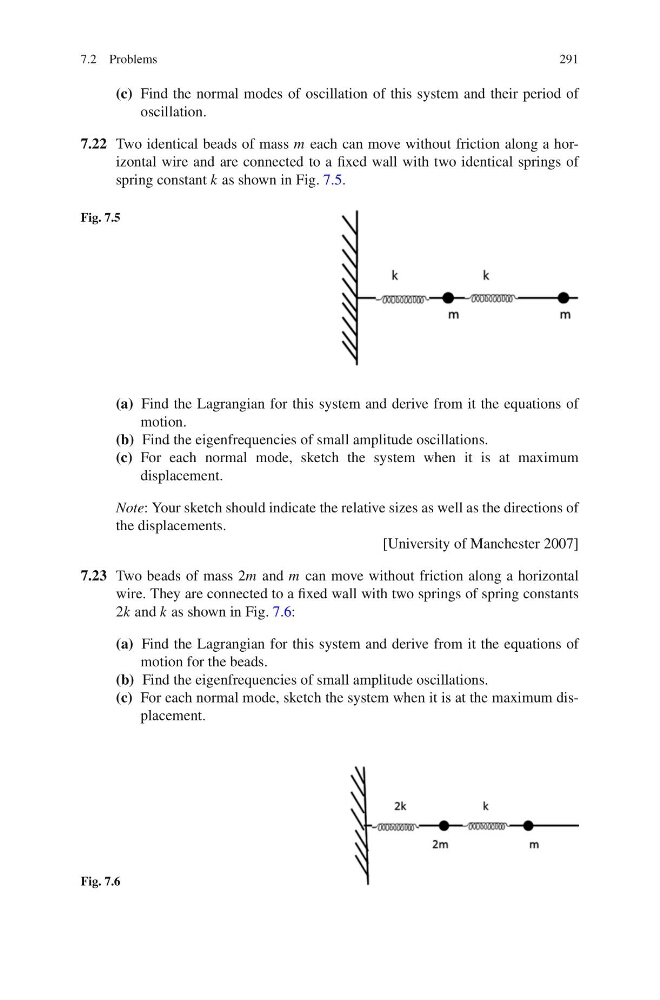
7.22 Two identical beads of mass m each can move without friction along a horizontal wire and are connected to a fixed wall with two identical springs of
spring constant k as shown in Fig. 7.5.
Fig. 7.5
(a) Find the Lagrangian for this system and derive from it the equations of
motion.
(b) Find the eigenfrequencies of small amplitude oscillations.
(c) For each normal mode, sketch the system when it is at maximum
displacement.
Note: Your sketch should indicate the relative sizes as well as the directions of
the displacements.
[University of Manchester 2007]
7.23 Two beads of mass 2m and m can move without friction along a horizontal
wire. They are connected to a fixed wall with two springs of spring constants
2k and k as shown in Fig. 7.6:
(a) Find the Lagrangian for this system and derive from it the equations of
motion for the beads.
(b) Find the eigenfrequencies of small amplitude oscillations.
(c) For each normal mode, sketch the system when it is at the maximum displacement.
Fig. 7.6
291
(c) Find the normal modes of oscillation of this system and their period of
oscillation.
7.22 Two identical beads of mass m each can move without friction along a horizontal wire and are connected to a fixed wall with two identical springs of
spring constant k as shown in Fig. 7.5.
Fig. 7.5
(a) Find the Lagrangian for this system and derive from it the equations of
motion.
(b) Find the eigenfrequencies of small amplitude oscillations.
(c) For each normal mode, sketch the system when it is at maximum
displacement.
Note: Your sketch should indicate the relative sizes as well as the directions of
the displacements.
[University of Manchester 2007]
7.23 Two beads of mass 2m and m can move without friction along a horizontal
wire. They are connected to a fixed wall with two springs of spring constants
2k and k as shown in Fig. 7.6:
(a) Find the Lagrangian for this system and derive from it the equations of
motion for the beads.
(b) Find the eigenfrequencies of small amplitude oscillations.
(c) For each normal mode, sketch the system when it is at the maximum displacement.
Fig. 7.6