

242
6 Oscillations
Calling R =
b 2 − ω 2
0
λ 1 = −b + R λ 2 = −b − R
Using the boundary conditions, at t = 0, x = x 0 and dx/dt = 0 the solution to
(6.47) is found to be
x =
1
2
x 0 e
−bt
(1 + b/R)e
Rt
+ (1 − b/R)e
−Rt
(6.50)
The physical solution depends on the degree of damping.
Case 1: Small frictional forces: b < ω 0 (underdamping)
b 2 < k/m or (r/2m) 2 < k/m
R is imaginary. R = jω
, where j =
√ −1
ω
2 = ω
2
0 − b
2
(6.51)
x = Ae
−bt cos(ω
t + ε)
(6.52)
where A = ω 0 x 0 /ω
and ε = tan
−1
(−b/ω
)
(6.53)
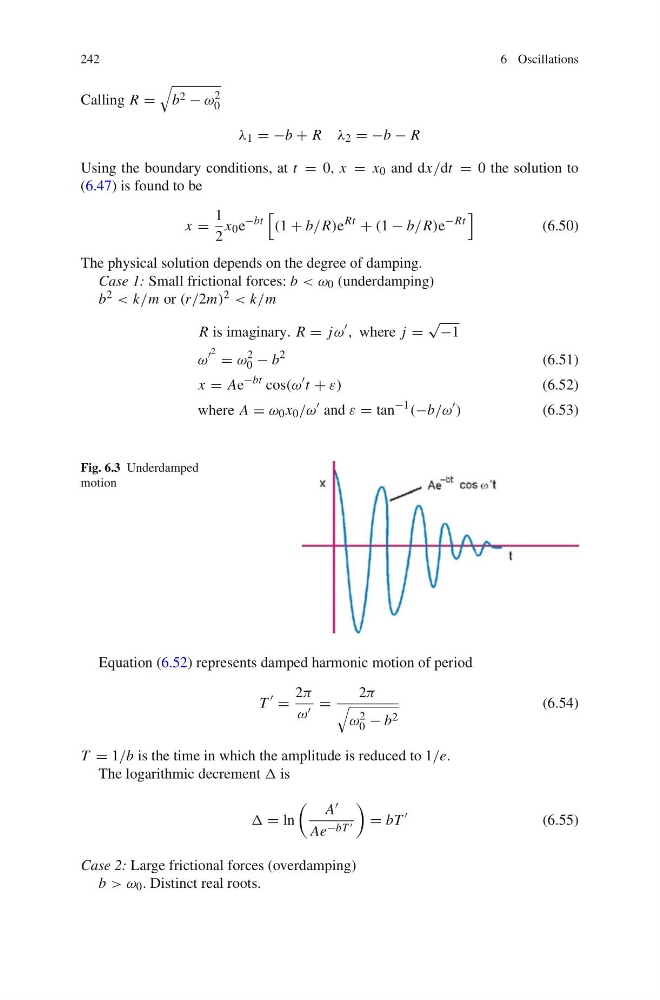
Fig. 6.3 Underdamped
motion
Equation (6.52) represents damped harmonic motion of period
T
=
2π
ω =
2π
ω 2
0 − b 2
(6.54)
T = 1/b is the time in which the amplitude is reduced to 1/e.
The logarithmic decrement is
= ln
A
Ae −bT
= bT
(6.55)
Case 2: Large frictional forces (overdamping)
b > ω 0 . Distinct real roots.
6 Oscillations
Calling R =
b 2 − ω 2
0
λ 1 = −b + R λ 2 = −b − R
Using the boundary conditions, at t = 0, x = x 0 and dx/dt = 0 the solution to
(6.47) is found to be
x =
1
2
x 0 e
−bt
(1 + b/R)e
Rt
+ (1 − b/R)e
−Rt
(6.50)
The physical solution depends on the degree of damping.
Case 1: Small frictional forces: b < ω 0 (underdamping)
b 2 < k/m or (r/2m) 2 < k/m
R is imaginary. R = jω
, where j =
√ −1
ω
2 = ω
2
0 − b
2
(6.51)
x = Ae
−bt cos(ω
t + ε)
(6.52)
where A = ω 0 x 0 /ω
and ε = tan
−1
(−b/ω
)
(6.53)
Fig. 6.3 Underdamped
motion
Equation (6.52) represents damped harmonic motion of period
T
=
2π
ω =
2π
ω 2
0 − b 2
(6.54)
T = 1/b is the time in which the amplitude is reduced to 1/e.
The logarithmic decrement is
= ln
A
Ae −bT
= bT
(6.55)
Case 2: Large frictional forces (overdamping)
b > ω 0 . Distinct real roots.