

6.1 Basic Concepts and Formulae
241
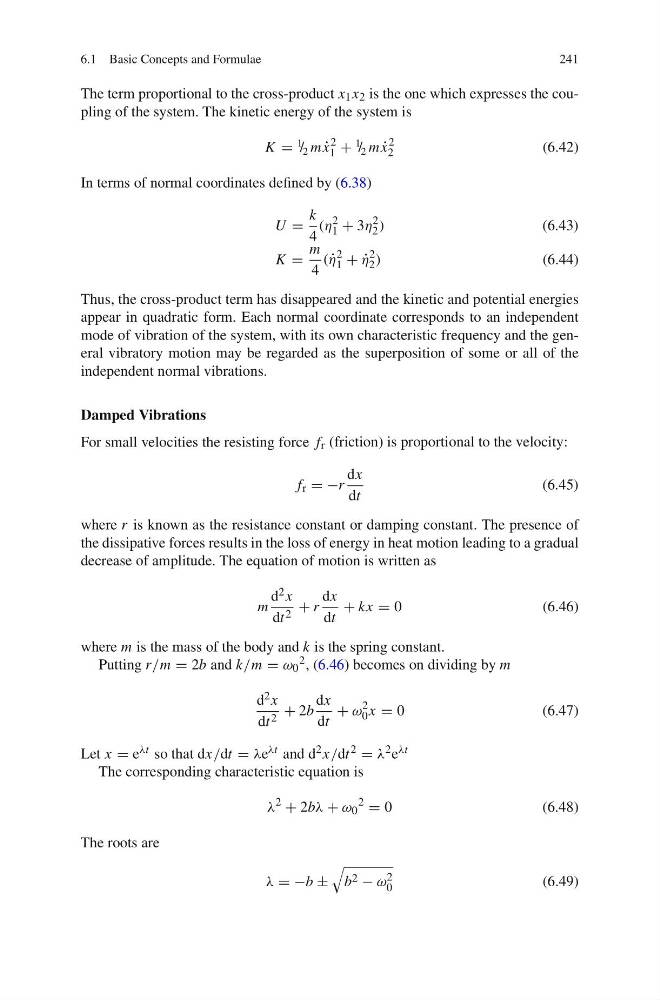
The term proportional to the cross-product x 1 x 2 is the one which expresses the coupling of the system. The kinetic energy of the system is
K =
1
/ 2 m ˙
x
2
1 +
1
/ 2 m ˙
x
2
2
(6.42)
In terms of normal coordinates defined by (6.38)
U =
k
4
(η
2
1 + 3η
2
2 )
(6.43)
K =
m
4
( ˙
η
2
1 + ˙
η
2
2 )
(6.44)
Thus, the cross-product term has disappeared and the kinetic and potential energies
appear in quadratic form. Each normal coordinate corresponds to an independent
mode of vibration of the system, with its own characteristic frequency and the general vibratory motion may be regarded as the superposition of some or all of the
independent normal vibrations.
Damped Vibrations
For small velocities the resisting force f r (friction) is proportional to the velocity:
f r = −r
dx
dt
(6.45)
where r is known as the resistance constant or damping constant. The presence of
the dissipative forces results in the loss of energy in heat motion leading to a gradual
decrease of amplitude. The equation of motion is written as
m
d 2 x
dt 2 + r
dx
dt
+ kx = 0
(6.46)
where m is the mass of the body and k is the spring constant.
Putting r/m = 2b and k/m = ω 0
2 , (6.46) becomes on dividing by m
d 2 x
dt 2 + 2b
dx
dt
+ ω
2
0 x = 0
(6.47)
Let x = e λt so that dx/dt = λe λt and d 2 x/dt 2 = λ 2 e λt
The corresponding characteristic equation is
λ
2
+ 2bλ + ω 0
2
= 0
(6.48)
The roots are
λ = −b ±
b 2 − ω 2
0
(6.49)
241
The term proportional to the cross-product x 1 x 2 is the one which expresses the coupling of the system. The kinetic energy of the system is
K =
1
/ 2 m ˙
x
2
1 +
1
/ 2 m ˙
x
2
2
(6.42)
In terms of normal coordinates defined by (6.38)
U =
k
4
(η
2
1 + 3η
2
2 )
(6.43)
K =
m
4
( ˙
η
2
1 + ˙
η
2
2 )
(6.44)
Thus, the cross-product term has disappeared and the kinetic and potential energies
appear in quadratic form. Each normal coordinate corresponds to an independent
mode of vibration of the system, with its own characteristic frequency and the general vibratory motion may be regarded as the superposition of some or all of the
independent normal vibrations.
Damped Vibrations
For small velocities the resisting force f r (friction) is proportional to the velocity:
f r = −r
dx
dt
(6.45)
where r is known as the resistance constant or damping constant. The presence of
the dissipative forces results in the loss of energy in heat motion leading to a gradual
decrease of amplitude. The equation of motion is written as
m
d 2 x
dt 2 + r
dx
dt
+ kx = 0
(6.46)
where m is the mass of the body and k is the spring constant.
Putting r/m = 2b and k/m = ω 0
2 , (6.46) becomes on dividing by m
d 2 x
dt 2 + 2b
dx
dt
+ ω
2
0 x = 0
(6.47)
Let x = e λt so that dx/dt = λe λt and d 2 x/dt 2 = λ 2 e λt
The corresponding characteristic equation is
λ
2
+ 2bλ + ω 0
2
= 0
(6.48)
The roots are
λ = −b ±
b 2 − ω 2
0
(6.49)