

6.1 Basic Concepts and Formulae
243
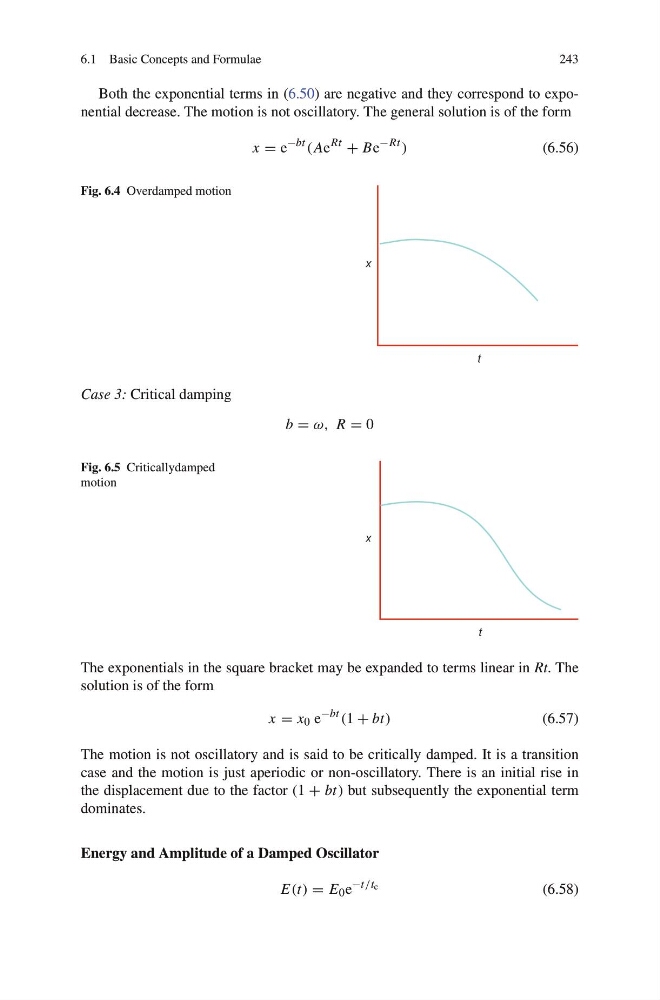
Both the exponential terms in (6.50) are negative and they correspond to exponential decrease. The motion is not oscillatory. The general solution is of the form
x = e
−bt
(Ae
Rt
+ Be
−Rt
)
(6.56)
Fig. 6.4 Overdamped motion
Case 3: Critical damping
b = ω, R = 0
Fig. 6.5 Criticallydamped
motion
The exponentials in the square bracket may be expanded to terms linear in Rt. The
solution is of the form
x = x 0 e
−bt
(1 + bt)
(6.57)
The motion is not oscillatory and is said to be critically damped. It is a transition
case and the motion is just aperiodic or non-oscillatory. There is an initial rise in
the displacement due to the factor (1 + bt) but subsequently the exponential term
dominates.
Energy and Amplitude of a Damped Oscillator
E(t) = E 0 e
−t/t c
(6.58)
243
Both the exponential terms in (6.50) are negative and they correspond to exponential decrease. The motion is not oscillatory. The general solution is of the form
x = e
−bt
(Ae
Rt
+ Be
−Rt
)
(6.56)
Fig. 6.4 Overdamped motion
Case 3: Critical damping
b = ω, R = 0
Fig. 6.5 Criticallydamped
motion
The exponentials in the square bracket may be expanded to terms linear in Rt. The
solution is of the form
x = x 0 e
−bt
(1 + bt)
(6.57)
The motion is not oscillatory and is said to be critically damped. It is a transition
case and the motion is just aperiodic or non-oscillatory. There is an initial rise in
the displacement due to the factor (1 + bt) but subsequently the exponential term
dominates.
Energy and Amplitude of a Damped Oscillator
E(t) = E 0 e
−t/t c
(6.58)