

212
5 Gravitation
∴ g(r ) = −
G M(r 3 − a 3 )
r 2 (b 3 − a 3 )
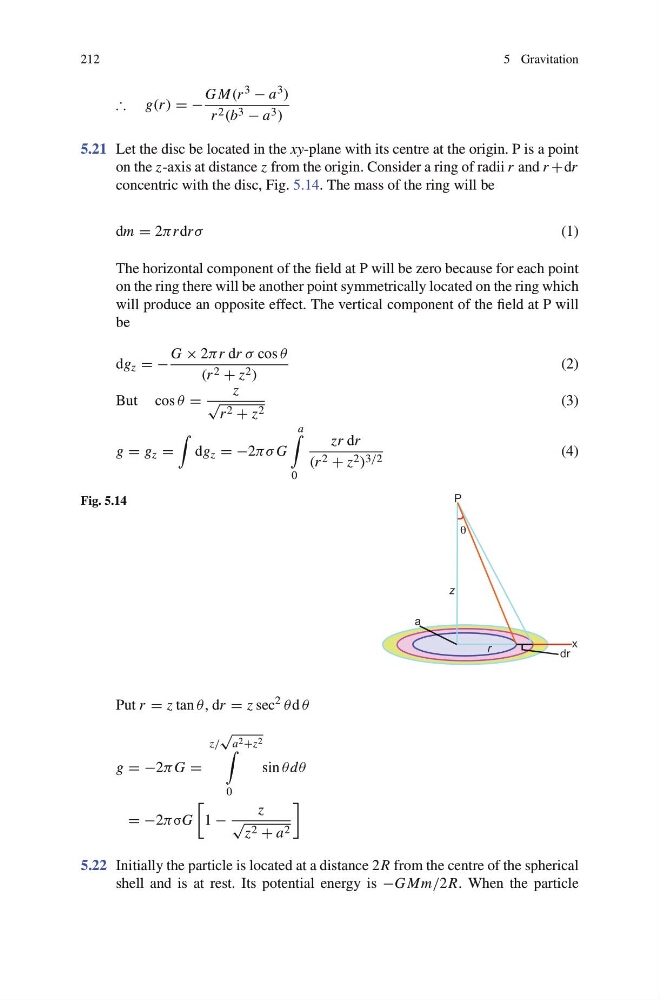
5.21 Let the disc be located in the xy-plane with its centre at the origin. P is a point
on the z-axis at distance z from the origin. Consider a ring of radii r and r +dr
concentric with the disc, Fig. 5.14. The mass of the ring will be
dm = 2πr dr σ
(1)
The horizontal component of the field at P will be zero because for each point
on the ring there will be another point symmetrically located on the ring which
will produce an opposite effect. The vertical component of the field at P will
be
dg z = −
G × 2πr dr σ cos θ
(r 2 + z 2 )
(2)
But cos θ =
z
√
r 2 + z 2
(3)
g = g z =
dg z = −2πσ G
a
0
zr dr
(r 2 + z 2 ) 3/2
(4)
Fig. 5.14
Put r = z tan θ , dr = z sec 2 θ d θ
g = −2π G =
z/
√
a 2 +z 2
0
sin θ dθ
= −2π σG
1 −
z
√
z 2 + a 2
5.22 Initially the particle is located at a distance 2R from the centre of the spherical
shell and is at rest. Its potential energy is −G Mm/2R. When the particle
5 Gravitation
∴ g(r ) = −
G M(r 3 − a 3 )
r 2 (b 3 − a 3 )
5.21 Let the disc be located in the xy-plane with its centre at the origin. P is a point
on the z-axis at distance z from the origin. Consider a ring of radii r and r +dr
concentric with the disc, Fig. 5.14. The mass of the ring will be
dm = 2πr dr σ
(1)
The horizontal component of the field at P will be zero because for each point
on the ring there will be another point symmetrically located on the ring which
will produce an opposite effect. The vertical component of the field at P will
be
dg z = −
G × 2πr dr σ cos θ
(r 2 + z 2 )
(2)
But cos θ =
z
√
r 2 + z 2
(3)
g = g z =
dg z = −2πσ G
a
0
zr dr
(r 2 + z 2 ) 3/2
(4)
Fig. 5.14
Put r = z tan θ , dr = z sec 2 θ d θ
g = −2π G =
z/
√
a 2 +z 2
0
sin θ dθ
= −2π σG
1 −
z
√
z 2 + a 2
5.22 Initially the particle is located at a distance 2R from the centre of the spherical
shell and is at rest. Its potential energy is −G Mm/2R. When the particle