

5.3 Solutions
211
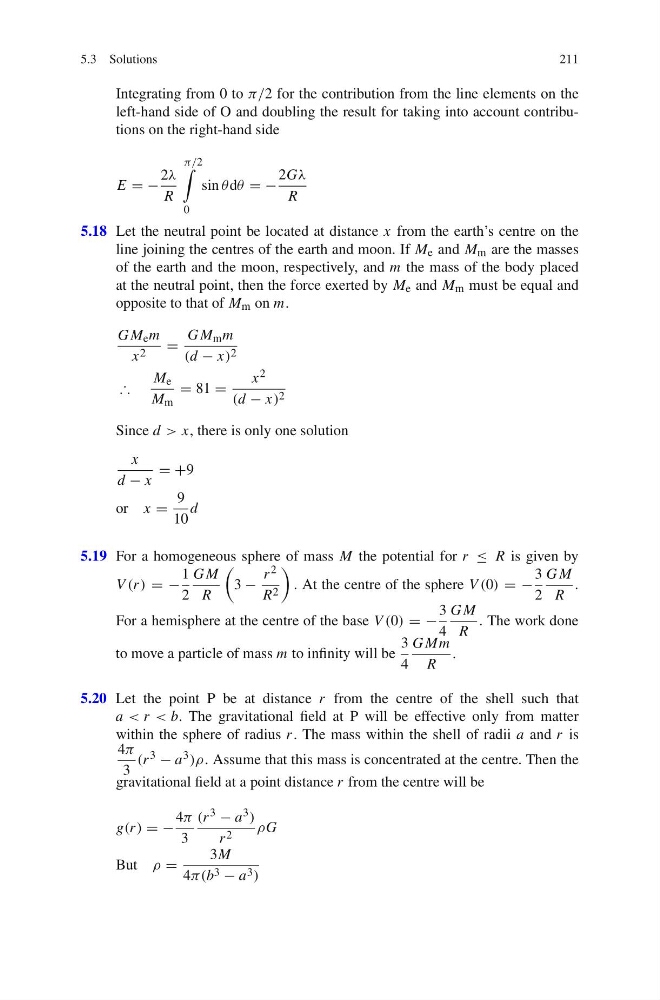
Integrating from 0 to π/2 for the contribution from the line elements on the
left-hand side of O and doubling the result for taking into account contributions on the right-hand side
E = −
2λ
R
π/2
0
sin θ dθ = −
2Gλ
R
5.18 Let the neutral point be located at distance x from the earth’s centre on the
line joining the centres of the earth and moon. If M e and M m are the masses
of the earth and the moon, respectively, and m the mass of the body placed
at the neutral point, then the force exerted by M e and M m must be equal and
opposite to that of M m on m.
G M e m
x 2 =
G M m m
(d − x) 2
∴
M e
M m
= 81 =
x 2
(d − x) 2
Since d > x, there is only one solution
x
d − x
= +9
or x =
9
10
d
5.19 For a homogeneous sphere of mass M the potential for r ≤ R is given by
V (r ) = −
1
2
G M
R
3 −
r 2
R 2
. At the centre of the sphere V (0) = −
3
2
G M
R
.
For a hemisphere at the centre of the base V (0) = −
3
4
G M
R
. The work done
to move a particle of mass m to infinity will be
3
4
G Mm
R
.
5.20 Let the point P be at distance r from the centre of the shell such that
a < r < b. The gravitational field at P will be effective only from matter
within the sphere of radius r . The mass within the shell of radii a and r is
4π
3
(r 3 − a 3 )ρ. Assume that this mass is concentrated at the centre. Then the
gravitational field at a point distance r from the centre will be
g(r ) = −
4π
3
(r 3 − a 3 )
r 2
ρG
But ρ =
3M
4π(b 3 − a 3 )
211
Integrating from 0 to π/2 for the contribution from the line elements on the
left-hand side of O and doubling the result for taking into account contributions on the right-hand side
E = −
2λ
R
π/2
0
sin θ dθ = −
2Gλ
R
5.18 Let the neutral point be located at distance x from the earth’s centre on the
line joining the centres of the earth and moon. If M e and M m are the masses
of the earth and the moon, respectively, and m the mass of the body placed
at the neutral point, then the force exerted by M e and M m must be equal and
opposite to that of M m on m.
G M e m
x 2 =
G M m m
(d − x) 2
∴
M e
M m
= 81 =
x 2
(d − x) 2
Since d > x, there is only one solution
x
d − x
= +9
or x =
9
10
d
5.19 For a homogeneous sphere of mass M the potential for r ≤ R is given by
V (r ) = −
1
2
G M
R
3 −
r 2
R 2
. At the centre of the sphere V (0) = −
3
2
G M
R
.
For a hemisphere at the centre of the base V (0) = −
3
4
G M
R
. The work done
to move a particle of mass m to infinity will be
3
4
G Mm
R
.
5.20 Let the point P be at distance r from the centre of the shell such that
a < r < b. The gravitational field at P will be effective only from matter
within the sphere of radius r . The mass within the shell of radii a and r is
4π
3
(r 3 − a 3 )ρ. Assume that this mass is concentrated at the centre. Then the
gravitational field at a point distance r from the centre will be
g(r ) = −
4π
3
(r 3 − a 3 )
r 2
ρG
But ρ =
3M
4π(b 3 − a 3 )